I am happy to report that the Africa Mercy has sailed out of the ASTICAN shipyard in Las Palmas! Don't get too excited though, we've only moved to the neighbouring island of Tenerife. We are back in almost the exact spot where we spent those 2 joyous months of quarantine/lockdown at the beginning of the pandemic. That does mean that we are now technically - geographically - further away from Senegal. But in the grand scheme of things, we are closer to our return now than we have been since that all started. Real, tangible progress is happening to facilitate 'Senegal 2.0' - the second phase of our field service during which we will complete our planned surgeries, continue to support & train local professionals, and reconnect & follow-up with some of our previous patients.
Speaking of training, take a minute to watch this update from an Ophthalmic surgeon from Togo. He is a shining example of the ripple effect that these partnerships can have. THIS is the most important outcome of the work that we do. Not the individual lives impacted (although each one is precious), but the exponential impact of equipping someone to serve and train others...who can in turn train even more! Emigration of skilled professionals away from low income countries is part of the reason that doctor-patient ratios there remain such a huge barrier to care. It is so heartwarming and encouraging to see someone who nearly followed that path, where he could have had a very comfortable life, but chose instead to stay and fight to better his own country.
Meanwhile, on the AFM...
I am still helping fill the Assistant Purser role for a little while longer before starting to shift towards Hospital prep. Preparation for the sail was a little stressful. Our sail day, however, was glorious weather and a much needed respite. I asked the Captain if we could just circle around for a few more days, but my request was, sadly, not approved. ;)
...our last sight in Gran Canaria!
Early start meant a beautiful sunrise...
Bye, bye, ASTICAN!
We still did *quite* a few circles to calibrate the compass. I'm sure some stomachs did not appreciate it.
We managed to squeeze in some worship on the bow - a Mercy Ships tradition!
The first (of many) Tenerife sunsets - just as the tug was nudging us in to port.
We have a few hurdles now here on a new island, but fortunately, in part because of high vaccination rates on the island (and within our crew), we have a fair bit of freedom to move around and explore - within a limited radius of the ship. Granadilla is a tiny, brand new port which is just beginning to be developed, so there is not a whole lot within walking distance except for construction sites, rocky desert and rocky shorelines. Which, to be honest, is fine by me. It's a nice change from the crowded streets of Las Palmas.
Lookin' pretty good in her shiny new paint job. As you can see...not much else around her!
Some veritably post-apocalyptic landscapes in the surrounding area.
So, here we will sit. And wait. A little while longer.
Just a few more months.
Senegal is on the horizon! Next time I'll try to share some stories from our Advance team who are already there, preparing the way for us to return.
Well, I'd better get back to my online course work for tonight. Learning about nearly every kind of wormy-parasite-type thing that can I could come across in my travels. What fun! Sorry for leaving you with that wonderful thought! ;D
Back on the ship, but not back to Africa. And things are not exactly back to normal, either.
How it started (when I arrived)
How it's going (progress from the last week!)
She looks much more herself now.
Right now the Africa Mercy is in drydock - pulled completely out of the water so that extensive repairs, upgrades and maintenance can be performed. There are, at last count, about 20 holes in the hull! That number has already gone down 50% from when I arrived, so progress is certainly being made. This work (plus more that will take place next year) should extend the life of the vessel by 15 years.
It is a strange time to be here, and a little bit difficult to feel settled-in. Because many systems are offline and being worked on (including the all-important air conditioning), only essential crew are living on board, the rest in a hotel. We commute to the ship every day to work, go 'home' at night, and must wear PPE anytime we are outside. It's akin to working on an active construction site - there is constant hammering, grinding, welding, painting and sand-blasting.
I am here to fill holes in the staffing schedule, which means I'll be bouncing around for a while before getting back to hospital projects. I'm starting out back at the reception desk, where we're temporarily sporting these lovely banana-yellow polos.
Me & friend/crew nurse Susy - with our extra PPE as we navigate the shipyard.
Reception may sound like a rather hum-drum job, but on the AFM it can be stressful at times, as it's a critical part of the safety & emergency response systems. Looking back at my posts from last year when I joined reception, I guess I never explained what goes on! The reception desk is manned 24/7 - emergency calls come to our desk, and we monitor the fire detection system. We are essentially the switchboard, the emergency dispatch, and the record-keepers for the Purser. What is a Purser, you ask?
Not this guy.
Glad you asked, since, as it turns out, I will also be filling in as Acting Assistant Purser for a couple of months. The Purser is responsible for a number of things: the ship's Articles (a contract between the captain and all crew under the laws of our flag state of Malta), facilitating the immigration process for all crew (both those flying in and out, and those on board when we sail in or out of a country), and, in essence, knowing where all crew are at all times in case of an emergency.
Eventually, I'm going to be transitioning into gradual hospital start-up projects; a handful of nurses are here and another good friend will be joining us in November. I'm also using this down time for some professional development that has sat on the backburner for a while: next week I'm starting an online diploma program on nursing in tropical settings which I'm quite looking forward too. It'll be a good challenge doing something academic again - dust off the ol' essay-writing skills - and hopefully help to keep my nurse brain firing on all cylinders!
Chugging along
That's a lot of updates from me, but I'd be remiss if I didn't mention some of the other exciting Mercy Ships news. Our new (big) baby sister ship, the Global Mercy, has made its way halfway across the globe from the shipyard in China towards Belgium, where it will get the final bells & whistles it needs to be both a functional vessel and a functional hospital. She's quite the sight to behold, and I can't wait to see her in person sometime next year! For now, enjoy these views from the Suez Canal passage. The Senegalese & Egyptian governments collaborated to accommodate the crossing completely free of charge. Check it out!
There's also some very exciting work happening back in Africa on several fronts!
In Senegal, our Medical Capacity Building teams have worked to organize more palliative care training - taught by graduates of our earlier programs! The course was at full capacity, and among the students were Cardiologists, Oncology nurses, and even an Imam.
Palliative Care training participants
Also in Senegal, we are working to facilitate surgery for over 100 patients on our waiting list through our local hospital partners. Health infrastructure & nutrition programs are ongoing, and our advance team on the ground is beginning to work out all the fine details required to bring the ship back in to port. The country just weathered out their biggest wave of COVID yet, and accelerated vaccination programs are still desperately needed. Only 7% of the population is fully vaccinated. Global supply is a major hindrance to the efforts to control this disease, and it is frustrating to see so much talk being talked but so little walk being walked on this point. The wealthy countries of the world had to get their lion's share of the pie before sharing the crumbs with anyone else.
As discouraging as the world's response is, it is still reassuring that overall case numbers have not climbed out of control in most of Africa, and though some hospitals are stretched, most are coping with these occasional spikes. This article does a good job detailing some of the whys, hows, and exceptions to these trends in Africa.
Sorry if I got a little bit preachy there. I have strong feelings.
Back to some good news: Mercy Ships was able to provide local hospitals in Liberia with portable oxygen concentrators - a crucial backup when conventional oxygen supplies are running low. Also in Liberia, Dr. Doug, an EENT surgeon, has been providing free surgeries and mentoring 3 local surgeons at one of the hospitals in Monrovia.
Dr. Doug receiving his Liberian license to practice!
Doug and his wife Darcey were part of my On Boarding class, and were desperately eager to return after the ship was delayed once more. A way was made for that to happen!
There is more going on on the continent, but I think if I go on, I might bore you! Suffice to say, although the ship isn't back just yet, folks are working hard to support our partners across Africa through this strange season. For myself, for now, I'm sittin' here sweating, answering phones, collating passports, & reporting alarms...looking forward to floating again, but much more to the day we sail back into the sandy streets of Dakar.
Thanks for reading, and for walking this road with me.
Nearly 6 years ago, when I first set foot on the Africa Mercy in Madagascar, I saw this model in a display case outside the crew bank:
The name on the bow was 'Atlantic Mercy;' she was to be the largest civilian hospital ship in the world, and the first purpose-built by Mercy Ships to better serve our host nations.
Since that day, when all that existed of her were draft blueprints and scale models, much has changed.
The organization has been steadily evolving towards more capacity building & training-focused programs.
The entire world has gone through a drastic reset.
The ship's name even changed. She's now the soon-to-be-commissioned, 'Global Mercy.'
The GLM showing off her maneuverability during recent sea trials.
It has taken a tremendous amount of effort to get to this point, and it has always been a highlight for me seeing the behind-the-scenes sneak peaks of the construction process. It's so exciting to see the final delivery quickly approaching! Having passed her sea trials (to certify her sea-worthiness), she will soon be on her way to Europe for the final 'equipping' stage, before her service will begin in Africa.
Here's a look into what went on during the sea trials:
In the meantime...COVID-19 has continued to throw wrenches into our expectations and plans. The good ol' AFM has been delayed again in returning to Africa, and instead will be going into drydock in Las Palmas for a partial refit that will extend its operational lifetime by ~15 years. That means that I will be 'drydocked' in Canada for a little while longer. This lovely, warm, spring weather will hopefully add a few years to my lifetime, too!
I think it's important to mention that, while the ship has not yet returned to Africa, we do have crew on the ground working in various capacities and countries to help deliver training, PPE and other supplies, and strengthen healthcare systems. Here's a little example of that from head Anesthesiologist, Dr. Sarah:
I am still in discussion with my manager regarding exactly when I'll be heading over again, but it will be...sometime in the next 2-6 months. I think.
'Redeeming the time' has become my mantra in this unexpected intermission. I expected to be, right now, right in the middle of another field service on the AFM in Liberia. Instead, I feel like I've been playing a game of 'wait and see' for the last 12 months. Waiting, hoping, praying for the right timing to safely return to Africa. Piecing together a plan to bide me over, a few months or weeks at a time.
I had been working for a while at a small community hospital, but more recently joined the Canadian Red Cross to support the domestic COVID-19 response. This is only an intermittent, reservist position, but has been a perfect stop gap to fill more stretches of time if and when they arise. With the CRC, I had the great privilege to participate in Operation Remote Immunity - the outstanding effort (spearheaded by Ornge) to vaccinate all eligible residents of remote, indigenous northern Ontario communities.
A great team of physicians, nurses, NPs and coordinators (all fully vaxxed - I should add)
I had a little break from the Red Cross to attend On Boarding - a Mercy Ships training program at the International Support Centre in Texas! But again, thanks to COVID, my attendance was purely virtual. On Boarding helps prepare long-term crew for the pressures of close-quarters living, a cross-cultural work environment, and a multi-denominational faith community. It was a great experience, and although I haven't yet been able to meet most of them in person, I definitely feel like I have a whole new group of friends - or rather - a new 'ship family.'
Onboarding Class of Covid April 2021
Immediately following this time of learning, reflecting & re-focusing, I was deployed to a border crossing site in Sarnia, where I am now facilitating the COVID self-testing process for land travellers.
The Bluewater Bridge Dream Team
I'm looking forward to a little bit of a break at the end of the month when this deployment wraps up, but also working out decisions for some other training I may need to complete before getting back to my floating home.
Until then, as we anticipate a return to global travel, and the deployment of the Global Mercy, I'll leave you with some words on the concept of 'ubuntu' - something which came up repeatedly during On Boarding.
It is a story which first came to light at the end of 2019, but I've held off writing until I felt I could give it the time it deserved.
It is a story about a servant heart.
Willing and Able
Osman was a soft-spoken young man from Sierra Leone, who joined the ship as day crew during the its 2011 field service there. He chose to continue serving as a volunteer, staying aboard as a plumber/engine rating, and completing training to be an Able Seaman.
"I like to use my hands to work to glorify God's kingdom." -Osman
Osman served in AFM engineering for the next 8 years, and he found ways to serve far above and beyond his day-to-day responsibilities. In Madagascar, recognizing the mobility challenges so many physically disabled people faced, he started salvaging old bikes to make hand-pedaled wheelchairs - built to handle the rough terrain of the run-down city infrastructure. He found individuals on the street who could benefit from these, and gave freely of his own time and effort to give them an independence which was otherwise impossible. Over the years, he would recruit other willing hands to help him in this work.
A happy recipient of one of Osman's spiffy chairs
I didn't know Osman well, but can certainly say I was always glad to see him come hustling down the hall. It was usually because the hospital ceiling was raining again (as it does from time-to-time), or a drain overflowing; never a nice reason to wake someone at 3 AM. Every time he would arrive with a smile and quickly attend to the problem. His job was far from glamorous, but he seemed to find joy in every bit of it.
Tested in the Flames
At the age of 13, Osman was nearly killed in a fire. With severe burns to his legs and arms, it was miraculous that he survived, after many months in hospital. The burns, however, left him covered in scars which pulled tighter and tighter over his joints. Without proper rehabilitation, he was soon barely able to walk, and was told by his doctors that amputation was the only solution. He would recall leaving the hospital feeling hopeless, pushing away his family and friends. During this period, a friend suggested he read the book of Job. Finding a kindred spirit in Job's suffering, he was led to a hope & faith which would get him through this difficult time.
2 years after his accident, news reached his family of the AFM's precursor, the Anastasis, arriving in Freetown. He would be admitted and operated on by Dr. Tertius Venter, a long-serving veteran of Mercy Ships. This surgery fully restored his mobility - allowing him to walk freely, return to school, graduate, and learn a trade.
A Familiar Face
Over a decade later, Dr. Tertius was onboard for another reconstructive surgery block. He passed Osman - unassumingly going about his duties - and did a double-take. He thought this crew member looked oddly familiar; and after a brief chat, discovered that this was the little Osman he had operated on back in 2001. For all the time Osman had been serving, few if any of his colleagues knew of his long past connection with Mercy Ships. He was quietly giving back, and in supporting the operation of the ship, helped so many others to overcome obstacles and suffering like his own. After this chance reunion, Osman & Tertius would become close friends.
Osman & Dr. Tertius in Cameroon (2017)
The Race Set Before Us
I sat in the weekly community meeting on the AFM, in late 2019, and heard the request for prayer for a crew member who was receiving treatment for cancer in South Africa. I'm sorry to admit it took a bit of social network snooping to remind myself who he was: the oft-called-in-the-wee-hours-of-the-morning plumber. Apparently, as a long-delayed complication from his burns, the cancer hit hard and fast, and Osman very quickly required an amputation. Dr. Tertius, whose primary practice is in Cape Town, helped facilitate his transfer there, and consulted in his care.
Calls went out for volunteers to help continue his wheelchair project in his absence. A collection from the crew allowed Osman's sister to travel from Sierra Leone to be with him, and Mercy Ships chaplains supported him through this time, as well. The cancer, unfortunately, spread beyond the amputated area.
In November 2019, Osman passed peacefully in the night.
Though our only interactions were like ships passing in the night, hearing Osman's story left a powerful impact on my heart. He overcame so much, he gave so much, and he did it with such a spirit of humility and grace that I can only aspire to.
"I was so happy to come with my skills and serve my brothers and sisters who also need medical help in the ship...I did not have money to donate to the ship, but I gave myself as a instrument to the to the lord so that others may also have their healing through Mercy Ships."
I'm very overdue for an update, a blog post, an anything...so buckle up!
The Good
Some of you may have seen the exciting, official unveiling of the Global
Mercy (GLM)! This new, state-of-the-art, built to purpose vessel will more than
double the organization's capacity to provide free surgery, and includes some
really fantastic features to improve our training capabilities (like a snazzy
simulation lab)!
But don't just listen to me talk about it...take a look!
I'm pretty darn excited about it! The hospital layout is going to be so much better - not just for us, but for our patients, as well. They'll have WINDOWS, a veranda they can always access, and overflow beds for caregivers. The wards have an enclosed nursing station, which is much nicer for night-shift, and will have computer stations for charting! That's right - we're moving into this century with digital charting!
The GLM just completed its first 'Sea Trials' where the engines & maneuverability were put to test, and exceeded all expectations. I'm looking forward to getting to know this ship when the transition happens - tentatively planned for late next year!
The Even More Good
Even better news, the BBC recently reported on the success of the government, professionals, and people of Senegal at keeping COVID-19 at bay. Several key factors here: they have an incredible infectious disease center (L'Institut Pasteur) which has developed several testing options (including an inexpensive, 15 minute test). They also were able to more than double their ICU capacity. Hearing that they started with only 10 - 12 beds equipped to care for COVID patients definitely drove home how vital it was that our crew not end up taking any of those much-needed spaces. Leaving was tough, but it ensured we would not become an avoidable burden.
The Bad
Unfortunately, COVID is still making it challenging to pick up where we left off. International travel is hard, and - for most people - may involve quarantines on either side of said travel. In the pre-pandemic days, we relied tremendously on short-term volunteers who spent as long as a few months to as little as two weeks on board. It's pretty hard to ask someone to leave their normal workplace for 6-8 weeks for only 2 weeks of actual service.
These factors drove the decision to postpone our return to April 2021; although as that date creeps closer, I'm still wary of how unpredictable this pandemic has been. Vaccine rollout is promising, but is still months away from having much of an impact on transmission.
The Unknown
So, here we are. The strangest Christmas in my lifetime after the most challenging year of my lifetime. I am incredibly grateful for everyone who helped support me through this unexpected furlough - from the trailer I was able to quarantine in, to family letting me bring my laundry over, to temporary job opportunities lining up and a living space falling into place. I have joined a reservist roster with the Red Cross, and so expect to be doing...well, something, with them come the new year. Could be COVID testing, could be vaccines, could be something else entirely! And where in Canada that will be is just as much up in the air. As is so often the case, though, the opportunity seemed to fall in my lap right when I was debating what to do next. So I am most grateful for someone who knows my needs before I do, and who always has a route mapped out, though I can only see the next few steps.
*cue relevant Disney musical number*
I am still tentatively signed up to attend On Boarding, the Mercy Ships training program for long-term crew, come March. This takes place in Texas, and I'm sure you can imagine my hesitance to travel anywhere in the US at the moment! I'm trying my best, though, to trust that map that I can't see, and the One who has already charted the course.
Thank you to all who have and continue to support me in this journey. I will leave you with this very awkward bundle of great memories from this time last year, and wish you all a very Merry Christmas & Joyeux Noël.
It's been almost 2 months since the AFM departed Senegal for Tenerife, and I thought I should fill you in on what's been happening since.
First news first: I have a tentative return date! I hope to be flying home on June 4th. I have found a place to safely quarantine before I re-enter this strange new version of home. I am seeking some sort of (ideally casual) work to keep me busy while we wait to find out when we can return to Africa.
There have been flurries of activity and quiet lulls on board, exciting days and tough days, but I'm grateful for friends that are still around while many have made it home. I'm also grateful for many activities and new places to work which have kept us busy and entertained during these interesting weeks.
My new work team! The AFM receptionists with our amazing Purser & Assistant Purser (ctr, ctr right)
Captain photobombs are best photobombs!
...we have fun keeping the ship safe.
Our hard-working galley crew now includes nurses, physiotherapists, & a dental assistant!
Our amazing Nepalese crew cooked a special dinner one night for the whole crew!
We played this pictionary-style game (with a secret twist) at one of our farewell dinners. Any guesses what either of these pictures are?
Our little walking track (must stay within the pylons & keep 2m from each other)
Shredding! Copious amounts of shredding of old, sensitive documents! Went through at least 3 of these jumbo bags.
Part of a thank you to our port agents for all they have done helping us settle in here! Each section of each letter was coloured by a different crew member.
So many beautiful sunsets over the mountains!
Although our primary work has had to come to a stop, we've tried to find ways to continue helping the nations of Africa, and the one that we're in! Our Africa Bureau has organized donations of PPE and essential medical supplies (that were intended for use in Senegal these last 2 months) for the Health Authorities of Sierra Leone, Madagascar, Liberia, and Benin. We also continue to follow-up & check-in on the progress of our patients back in Senegal, via our day crew and other local contacts.
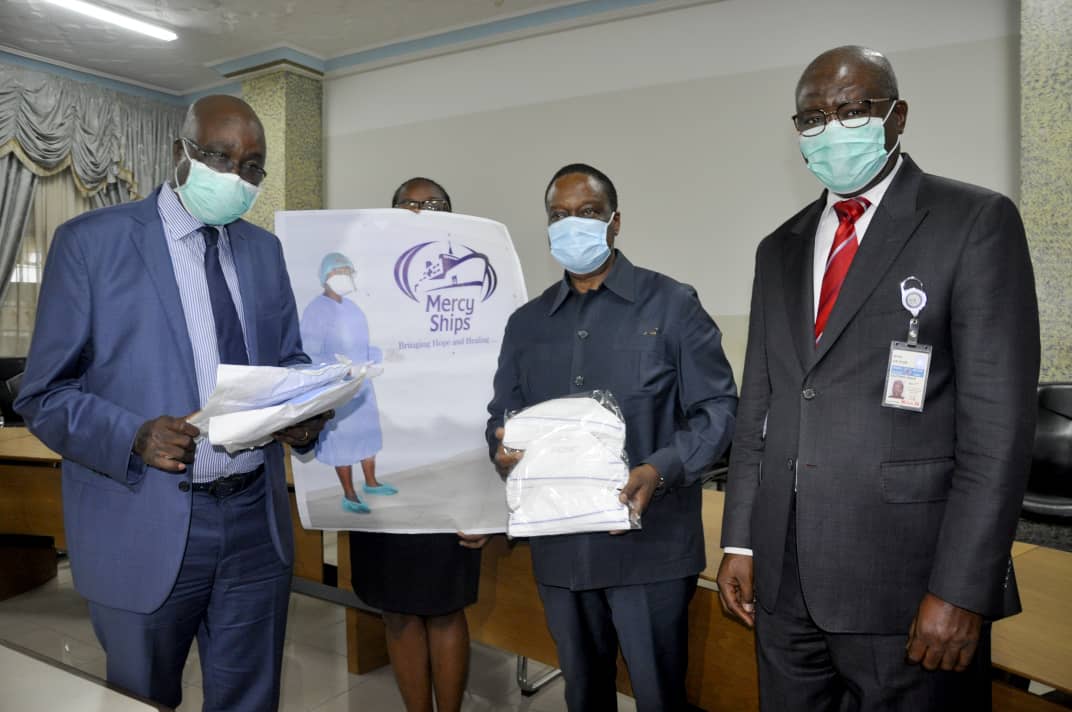
Donated supplies in Benin including surgical gowns, masks, gloves, caps, and eye protection.
This photo keeps popping up on MS social media but I feel so bad for the lady holding the poster!
More supplies ready to ship to Sierra Leone
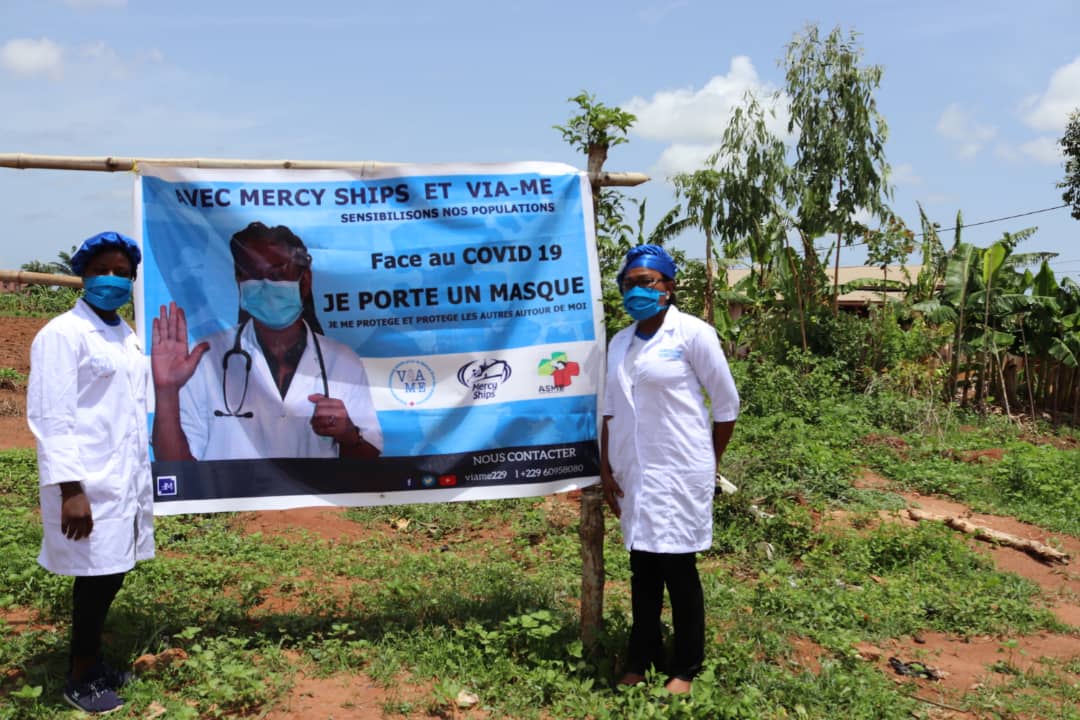
MS alumni, Dr. Odri Augbessi is spearheading a public awareness campaign in her country of Benin.
Dr. Sarah Kwok hands a donation of PPE over to the Spanish Red Cross
Hopefully that helps give you an idea of what's still going on over here! We're doing our best to stay busy, and help where we can.
And, in case you missed it, here's the overview of what we did accomplish before leaving Senegal (See if you can spot me - I made it in there twice)!
Looking forward to being 'home,' although it will certainly be an interesting adjustment.
As I was going about my business this morning (enjoying a rare opportunity to stream some of my favourite tunes while the internet holds up) I reached for my multivitamins and was reminded of something. A small detail from over a month ago that was lost in the fog of chaos at the time. I opened the safety cap, pressing down and twisting, and was brought back to the beautiful, weathered & wrinkled face of an older woman.
I don't remember the details of the patient - heck I'm not even sure which specialty they were - other than it was a child with an elderly grandmother as a caregiver. They had several liquid medications; as I was working through each one, explaining their purpose, when to give them, and how much, we came across a bit of a snag. Grandma was a champ with all the details, repeating the information back to me perfectly. But then I asked her to practice giving a dose of paracetamol.
It's not uncommon for people to have trouble with the child safety caps the first time they encounter them, which is exactly why I asked her to give it a try. This dear woman, though, despite multiple demonstrations & explanations, just could not get that cap to open. My translator and I spent a good 5 minutes on it, and though she continued to smile and laugh through the struggle, I could tell she was getting frustrated. She even tried to fake us out a few times, spinning the cap and nodding as if she had gotten it!
Finally, I reached across my translator to take the woman's hands into mine. I held the bottle, pressing her hand down on the top, and we both twisted together, successfully getting the lid all the way off. We did this once more before she was able to finally get it done on her own, multiple times, and I was confident she would be able to manage at home.
Such a trivial part of my usual day was a nearly insurmountable task for that woman. It was something she couldn't work out without experiencing what the mechanism felt like. Something no amount of explaining or demonstrating could achieve. We needed to walk together through the process, doing the work side-by-side - or hand-in-hand, in this case.
This woman was teaching me, although it took it a month to sink in, an incredibly important lesson.
Loving, serving, teaching, 'helping...' can often be a self-serving exercise that feels good for us but leaves no lasting impact on others. It's not enough to throw money at a problem, to say some half-baked platitudes, to say, "I'll pray for you," if we aren't willing to walk through the challenge with them. Empathy is one of those concepts they talk about a LOT in nursing school. I don't think it's importance can be overstated in this profession, but I also don't think it's something that can be taught in a classroom. It's something you have to experience. You have to stand awkwardly under the wing of a more experienced nurse while they help a patient through pain - physical, emotional, spiritual, or social - and you begin to understand empathy in practice. You have to resist the urge to laugh at what might seem a stupid question, and realize how unsettling and scary it would be if you didn't know the answer. Your patients teach you how to imagine their experience through their eyes, and walk together with you down this road of better understanding.