Life always seems to get ahead of me when I'm at home, and it's harder to find time to sit down and write. I actually started this post back in May, and I'm only just getting around to finishing it. Sorry.
So I guess that means it's time for:
A quick update!
Mercy Ships Canada has changed their donation system, meaning my donation page has changed.
It can now be found HERE, or tinyurl.com/crewmate2 also works if you'd like something short and easy to share.
A few items of thanks
I'm fortunate enough to have very flexible landlords who have arranged a short-term sublet of my furnished apartment while I am away, meaning I only have to pack and store my personal items. Most of my larger belongings can hang tight right where they are.
I had a little money that carried over from last year's fundraising, and a few new donations came in; just enough to book my flights to Senegal. I now need only cover my costs for monthly crew fees.
My wonderful parents, and good friends Rob & Sue are already getting the ball rolling on our (now) traditional brunch fundraiser. I'm so grateful for their eagerness to support me, and seemingly boundless energy! PS IT'LL BE JULY 27TH SO BE THERE AND GET FED.
Now that that's over with...
On with the post!
The Africa Mercy is a pretty neat ship - granted, I haven't been on that many ships - but I suspect it has a fairly unique list of ports of call compared to your average passenger liner. In its journeys, from its time as a Danish train ferry to its current life as a hospital ship, it has visited a good chunk of the world. Serving in this particular part of the world, where culture is as deep and rich as the red sands of the roads, that culture has rubbed off on the AFM (and I don't just mean the harmattan dust).
There is a veritable smorgasbord of (mostly) West African art adorning the walls and corridors, many of them gifts of gratitude, from the nations where the ship has served. Since I'm currently just hanging out at home with not much news to share, I thought this would be a fun little filler post to bide us over. Therefore, I shall now shut up and let the art (and a few quotes from everyone's favourite painter) take over from here. Click on any pic to embiggen.
“You have to allow the paint to break to make it beautiful.” ― Bob Ross
“We don’t laugh because we feel good, we feel good because we laugh.” ― Bob Ross
“It’s hard to see things when you are too close. Take a step back and look.” ― Bob Ross
Whoops! How did that get in there...hardly fair comparing this to canvas and paint.
“You can do anything here — the only prerequisite is that it makes you happy.” ― Bob Ross
“Go out on limb. That’s where the fruit is.” ― Bob Ross
Left: plaque showing the outreach locations teams reached from the ship's location in Tamatave, Madagascar.
Right: One of several statues gifted by the leadership of Benin. Its attire was not exactly..."family friendly." Thus the addition of a little tube top.
Well, that's about all I was able to capture back in March. Hope it gave you an idea what it's like to stroll around the AFM, and the rich and vibrant places it has visited. À la prochaine...
Patient "A" (for the sake of this, let's call him 'Andy') was one of a handful of patients in the hospital when I arrived in January. He had had surgery for his bowed legs back in December, but had some unexpected complications which kept him stuck on the ward over the Christmas break. Our team of hospital physicians were initially mystified by his unexplained fevers, but eventually their research, and some test results, gave us a clue as to what was going on.
He was becoming severely neutropenic - his white blood cell counts were far below normal. Essentially, his immune system was compromised for some reason. He had been perfectly fine before surgery; this is something we routinely check for a pre-op baseline. The only explanation our docs could come up with was that it was an uncommon and drastic reaction to a particular antibiotic he had been given. In digging a little myself, I could only find 3 or 4 similar cases mentioned in published literature. As soon as the link was made the antibiotics were stopped, but it took weeks for his system to recover.
Weeks during which he had to be "reverse isolated:" anyone caring for him had to gown and mask up, he couldn't have visitors, and we kept his side of the ward empty aside from him and his mother. If he left the ward, HE had to wear a mask. Any mild infection could have wreaked havoc while he was so compromised, and he still had an open wound on his leg which was taking its jolly time to heal. He still had casts on both legs, one of which was split so we could access his wound, then wrap it back up tightly together. Because of the risk of infection and his delayed wound healing, "Andy" wasn't nearly as mobile as he should have been this long after surgery. This was causing even more delays in his bone healing.
WARNING - MILDLY ICKY MEDICAL STUFF IN THIS PARAGRAPH
I haven't ever talked about our Ortho specialty much because I haven't seen much of it myself - so I'll explain a little what goes on. Most patients we see have a congenital condition that worsens as they grow older, and can become astoundingly severe in our older patients. By older, I mean teenagers. Kids' bones are different than an adult's; they're still growing, and they heal faster. Correcting these windswept or bowed legs requires cutting the bones, over-correcting the deformity, casting them in position then getting the kids to walk. That's the hard part. The weight and pressure from walking actually brings the fragmented bones together. It is a much more complicated and less successful process for adults, which is why our Ortho service is almost exclusively pediatric. Kids' bones have a little bit of give to them, which is why the Ponseti Method works so well to fix club feet.
ICKY STUFF DONE!
All this is to say...'Andy' had a rough go of it. He had painful, daily dressing changes, walking was still hurting a lot, and for a few weeks we couldn't even give him a high-five without putting on gloves. The first shift I looked after him, he was absolutely INCONSOLABLE when he saw me getting pain meds for his dressing change. Literally screaming and flailing his arms. His mother wouldn't make eye contact with me as I tried to indicate she should try to help calm him down. She sat, staring at the floor, as tears streamed down her son's face. I was bewildered, and my translator seemed bemused, but we did manage to get the meds into him. After a bit more wailing as I started the dressing, 'Andy' calmed down, distracted by some games on an iPad while I worked. A while later, when another translator was free, I was able to talk to the mother and get a better grasp on the situation.
Numerous tests had been done over the previous few days, and no one had really told her the results. It had been the weekend, the Orthopedic surgeon was gone, and likely everyone assumed someone else had already explained. It's also possible there was no translator available for her language. The mother, as a result, had assumed the worst she could imagine. Communication mishaps happen enough when there isn't a language barrier. It's so much more likely in this situation. To make a long story short, I was able to reassure the mother, our lovely Dr. Laura also came by to explain the test results in more detail, and mother was much happier - and much more helpful with meds and procedures. And she was always fastidious about hand hygiene, pumping dollops of purell onto her son's hands for him.
'Andy' remained a bit - how shall I say - moody? He could be your best pal one day then glaring and brooding the next. But I suppose that can be par for the course with a teenager.
THIS WAS A BROODING DAY.
THIS WAS A GOOD DAY.
Eventually, as expected, his test results improved enough that we could stop with the reverse iso precautions, and his wound began to heal, albeit slowly. Out of nowhere, too, he got a sudden burst of motivation. He went from refusing to walk the length of the corridor to kicking around a soccer ball and CLIMBING STAIRS a few days later.
I think the chance to see the bridge was pretty good incentive - big props to Captain Milo for making that happen.
I didn't see 'Andy' much over the last few weeks before I left, as he was out at the HOPE Center and only coming by for dressing changes and rehab a couple times a week. But I heard from colleagues that his wound is nearly closed, and he's not letting much hold him back now.
The long-awaited day of discharge from the hospital!
My time in Guinea has ended, and boy did it go out with a bang.
My last few shifts were...surprising - I think is the best word.
I started working some shifts as a charge nurse this year. I was a tad apprehensive at first, but after some orientation and a couple shifts under my belt, I felt fairly comfortable about it. I had already completed the 4 charge shifts that were on my schedule, but I ended up trading to help someone out and was in charge again Tuesday evening.
EVENING ONE - SPORTBALL
The shift went by without much excitement until about 8:30, when a nurse asked me to look at her hernia patient. "There's a LOT more swelling than there was." In about half an hour, he had gained a softball-sized bulge that was definitely not there before. I paged the surgeon, who came down to look and wrote orders to take the patient back to the OR in the morning. He was bleeding, but it wasn't severe enough to warrant surgery that night. Page back if it gets to be football-sized. Ok, that's what we'll do, I guess. I let the OR team know, got a consent signed, and checked in with the team leader to make sure I hadn't missed anything important.
Apparently I didn't notice that I had been sweating buckets even just sitting at the computer, because it's HOT in our ward, and a nice little dizzy spell forced me to take a breather and remember to drink water. One of the night shift nurses had made pies, so I got a piece and moved to the air-conditioned office to finish up my work. By the time I updated all the paperwork for the morning shift, I's dotted and T's crossed, I finally left - a round midnight. Slightly uneasy about the still-slowly-bleeding patient, it was even later by the time I fell asleep. No bother, I could sleep in.
EVENING TWO - DÉJÀ VU
Arriving on the ward, my team leader said, "Surprise! We need you in charge again!" No problem, I handled last night, and it can't be as crazy as that again.
The bleeder from yesterday was doing fine, and everything was run of the mill until about 9; shortly after the surgeons had done their rounds. "My kid in bed 1 suddenly has all this swelling." You're kidding me. Paged the surgeon, he took one look and asked, "When did he last eat?" Great. Needs to go back to OR tonight. Once again, notified the OR team, consent, paperwork, find a translator that can explain everything to mama, and he's whisked out of the ward before shift change at 10.
Just as I'm bringing my print-outs for the morning shift back from the office, around 11, the phone rings. "That was quick," I think as I answer, expecting the news that they're bringing him back out of recovery.
It's the OR nurse, Melissa. "Did the day nurse say anything to you about a blistery rash?"
"Wha...?" I double check with the night nurse who got report. "No, no one saw anything..."
"We THINK he might have Chicken Pox."
No freaking way. After a moment's disbelief, we discuss what to do and I jog down to D ward to make sure there's an isolation room free. The doctor on call needs to verify before we can do anything - it's a sweet English lady who usually works ashore in Capacity Building. She's never been in the OR and I help her gown up and direct her to the recovery room. "This is what I get for offering to cover the pager," she jokes.
Sure enough, she's 99% sure it's Varicella. We have to isolate. Once again I track down a Mandingo speaker to explain everything to mum, and escort her to the iso room. It's full of extra ICU equipment which we hurriedly haul out of the way. Shortly after, her son arrives in Melissa's arms, and I help the night nurse get him settled in bed. It's after midnight by now, and our infection control nurse turns up (bless her). We all chat about the plan, no, it's not ideal, we don't have a negative pressure room, but it should be ok, it's more droplets that we need to worry about, they SHOULD be able to go home in the morning.
Around 1 AM, at the insistance from the night nurse that she would manage (despite having this patient plus 8 more in a different ward), I went off to bed.
EVENING THREE - MISGIVINGS
My last shift before I head home. I'm not in charge. Phew. I'll just manage my patient load, no surprises, no problem. Right? Heh. There's some acute patients in D ward, so they've borrowed some of our staff, leaving us with 6 patients each. One of mine is our chicken pox patient. They're from upcountry, and need to stay close by until their 1 week follow-up appointment. We can't send them back to the HOPE center - he's still contagious. Mama doesn't know anyone in Conakry she can stay with, so we're going to try to put them up in a hotel.
Going back and forth between iso and A Ward (opposite ends of the hospital), I'm trying to get myself organized and make sure I've checked on all my patients when Lizzie, the infection control nurse, tells me they've organized a place for our pox patient to stay. "I've still got to do some teaching," I tell her; she's going to come back with a chaplain who can translate for us.
After about an hour explaining the plan to mama, making sure she understands the medications and can open the stupid child-proof bottles (that is not as easy as you might think to explain in a different language), we finally started to head out. Mama stopped short outside the door and said something to the chaplain. "She wants you to pray for her," he tells me.
"Me? Are you sure? In English? Would she prefer you pray in Mandingo?"
They converse a little, and he says, "Yes, you pray, I will translate."
I don't know what that mama believes, but in that moment she knew she needed someone greater than her to get her through the week ahead. Lizzie later shared that when they reached the hotel, Mama was pleading that they not leave her there. She had lived her whole life in a remote, rural area; being in a huge city like Conakry was terrifying to her. At the HOPE center there are translators and other patients from all over the country; there's always someone you can talk to. It's safe, secure, and familiar.
She did not want to be alone.
Lizzie and Christopher, the chaplain, were able to find a staff member at the hotel who could speak Mandingo, they helped settle mama in, reassured her that staff from the HOPE center would see her every day to bring meals, and gave her an emergency contact number. It sounds like by the time they left she was more at ease.
~ ~ ~
Once the two of them were off in Lizzie's capable hands, I rushed back over to A Ward, where I had left a fresh post-op patient for far, far too long. "Your vitals are done, and I gave bed 7 his paracetamol." My fellow nurses are rock stars.
I again was in the hospital till after midnight, cleaning the iso room from floor to ceiling with my charge nurse's help.
~ ~ ~
I don't think I'd trade those 3 crazy shifts for any one shift here at home. They were stressful, but I still walked away feeling fulfilled, effective, and oh so appreciative for the professional team who, despite being from different countries and speaking different languages, work so well together to share the load and show our patients love.
I'll miss you Guinea,
And you too AFM - but I'll be climbing back up the gangway before long.
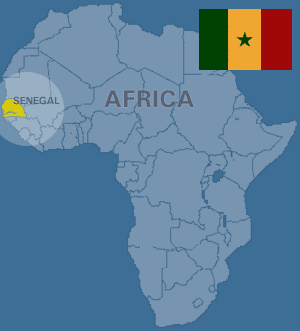
Whelp, I'm officially signed on to serve for the entirety of the Africa Mercy's field service in Dakar, Senegal; for nine months, give or take.
I was able to post a bit more frequently in January, as the hospital wasn't very full, but now we're overflowing (literally: we're opening our small, overflow ward next week)! I've thus been working a good deal more and haven't had much time for a "life admin" day where I could blog and catch up on email. The email that appeared 2 days ago from the Mercy Ships Senior Staffing Manager, though, warranted some reflection and careful consideration.
I have felt a pull to commit to a longer service here on board for some time now, and I finally realized I could keep coming up with excuses to put it off for ages and ages if I didn't get my act together and jump for it. It was a bit like working up the gumption to jump from a high cliff into the water below; you know the water's deep enough, you know you'll have enough breath to make it back up to the surface, but pushing off that solid rock beneath your feet is still hard to commit to. I'm particularly bad at this...I will stand up there for 10 minutes thinking about jumping before I manage it. So I knew I needed to stop waiting for a sign or some perfect sequence of events to align, and just DO IT already.
OK OK OK - Doing it.
So, now my mind is racing with all the things I'm going to have to organize between now and then - and I'm still here! Trying to focus on the present and our patients. Thyroid surgery wraps up today (sure saw some incredibly huge goiters), and we'll be back into hernias and lipomas. With a side of burn contracture releases - their grafts take a few weeks of TLC and close monitoring before we can send them off-ship, so quite a few of them are hanging out with us.
All our goiter patients with the screening team - the seated lady on the far right had the largest by far!
Our plastic surgery patients, in particular, require a lot of extra protein and calories to build lots of happy, healthy tissue over their graft sites. So this has pretty much been the non-thyroid side of our ward the past few weeks:
Those packets are a peanut-based supplement that we make into milkshakes and...gently coax our patients into drinking.
A few weeks ago we also had a run of cranio-facial surgery; this little champ had an encephalocele - a birth defect where skull development is incomplete and part of the brain tissue ends up outside the skull. It's slightly terrifying yet awe-inspiring that we are able to perform such a complex surgery here, and quite successfully. Fortunately we have some great specialists, including neurosurgery nurses, who were able to manage the many delicate tubes and beeping machines keeping these little ones stable while they recovered. The odds of surviving to adulthood with an encephalocele are about 50/50 - so it's pretty exciting we could change the odds for each of these little ones.
Back to Senegal though...
This will be Mercy Ships' first field service in Senegal - but not their first visit! The AFM made a stop-over last year to briefly meet & greet the local authorities whose collaboration and support is key to making the field service a success.
As I've said in the past, there is an insane amount of preparation and work that goes on behind the scenes, years before a field service even begins.
Senegal is, evidently, significantly better-off than Guinea. Like most countries in this region, however, lack of infrastructure and development in rural areas is a problem. Those living far away from the capitol city of Dakar, where many health services are available, are fresh out of luck. An excerpt from the Advance Team's assessment:
"Regarding surgeon to patient ratio, there are not enough surgeons for the amount of patients needing surgery, which causes a backlog of patients. This backlog is also increased by the cost of surgery. Skills are not necessarily lacking, especially in Dakar, but surgeons are overwhelmed."
This backlog means that the few professionals that are around are so overworked they rarely have the opportunity for professional development. In a profession that is so constantly changing, ongoing education is essential. Mentoring and training will therefore be a key part of the field service, in addition to relieving some of their surgical caseload.
Alright, I think I've rambled long enough, and dinner is calling my name.
The past week and a bit has given me quite a lot to think about - my brain might be a bit mushy but I always appreciate the chance to see things from a new point of view.
The most EXCITING thing to see last week was seeing people seeing! That, uh, sounds strange - but it's really the best way to describe it. Adult cataract surgery continues all year, but the last two weeks were exclusively for kids, who have to be put under for the procedure. The buzz around the hospital seemed to grow and spread throughout the ship, because by the last day there were so many people coming to watch the eye patches come off, they filled the hospital ward! Some kids were slow to adjust, having a hard time with the bright lights and the pain, some were looking all around straight away, and some were just plain stubborn:
Mama: "Ouvrez les yeux."
Kid: "Non."
Mama: "OUVREZ LES YEUX POUR LE DOCTEUR!"
Kid: "NON!"
Doctor:
I also had the opportunity last week to learn some of the ropes in sterile processing - the place where surgical instruments are cleaned, sanitized, packed, and sterilized! Here I am (all PPE'd up) with Roximo, a crew member from Sierra Leone who has worked in the department for a few years.
Every instrument is re-counted here once brought from the OR, to ensure nothing was left behind (or accidentally thrown out)! Each one is then scrubbed by hand, before being sanitized: either in one of the high-powered washers you see above, or an ultrasonic cleaning thingamajig for the more delicate instruments. THEN, moving to the non-contaminated side of the room, everything is dried and counted into individual, surgery-specific trays, packed, labeled, sealed, registered, and fired up in the autoclave. Whew. I'm tired just writing that. Every step of the surgical process, including all supplies that might be brought in, is meticulously structured and documented to cut down any potential risk of infection or misplaced items. Nobody wants something like this to happen:
This is also why our Medical Capacity Building program has a strong focus on safe surgery mentoring, utilizing the WHO's checklist program as the ideal standard.
It was pretty cool to see things from the other side of the hospital (literally - the ORs & Sterile Processing are on the starboard side of the ship, and the wards are on the port side). Typically, not just anyone can wander down that corridor - but I was able to poke my head in the window of OR 5 to watch one of the last pediatric cataract cases for a minute! If you're curious, and not squeamish, here's a decent video of the process. I also scrubbed, ultrasonically blasted, counted, packed and sterilized some cataract procedure trays from start to finish, which was pretty neat.
You might have seen on facebook that we're having a bit of an issue with water supply here on board. Ordinarily, at port, a local water supply is piped in to fill our tanks (after being run through our own purification system). Unfortunately, at the moment, there is little to no pressure in our intake, and the local authorities are just as baffled as us. Thus, we have been relying on water tankers (see above) to maintain our supply. 10 trucks a day. Each one taking 1 hour to unload. With over 400 people on board, you can imagine how much water we go through each day. Subsequently, our water usage has been restricted to "at sea" standards. One load of laundry a week, 2 minutes of water use per shower...you get the picture. Nothing gives you a new appreciation for something like not having enough.
During my down time, trying to avoid needing a shower...I have instead caught up on some reading. I have my sister to thank for this particular book, which gave me some new insight into the impact of the Korean War. I highly recommend it, but WOW some parts were tough to read. The author shares memories of her childhood as a Korean War orphan. Abandoned because of the shame she brought to her family, her father an unknown American serviceman; it is a story of overcoming prejudice, and surviving the worst of what nature and mankind could throw at her.
To end the week, I had the chance to see the city and the ship from a different vantage point, which is always a cool experience. The ship seems massive while walking the decks or standing beside it on the dock, but from out in the harbour, it is dwarfed by the surrounding cargo ships.
Can you spot it? (Click to embiggen)
It's easy to get into a mentality where we assume our presence is widely known within the country, and that surely everyone knows about the work we're doing on board. While it's true that many people in the street recognize us as "Mercy Sheeps!" people, seeing our little tin can compared to the expanse of Conakry around us is a good reality check. We are barely making a dent in the needs of this country. It is so important that we do the very best job we can to maximize our impact, and leave behind people who can continue the work.
Speaking of which...
Fun fact: the number of cleft lip cases we've seen this year has dropped by 80% compared to the last time the ship visited Guinea (2012-2013)! Guinean surgeons who received training through our mentorship & training programs are effectively tackling the problem on their own. How cool is that.
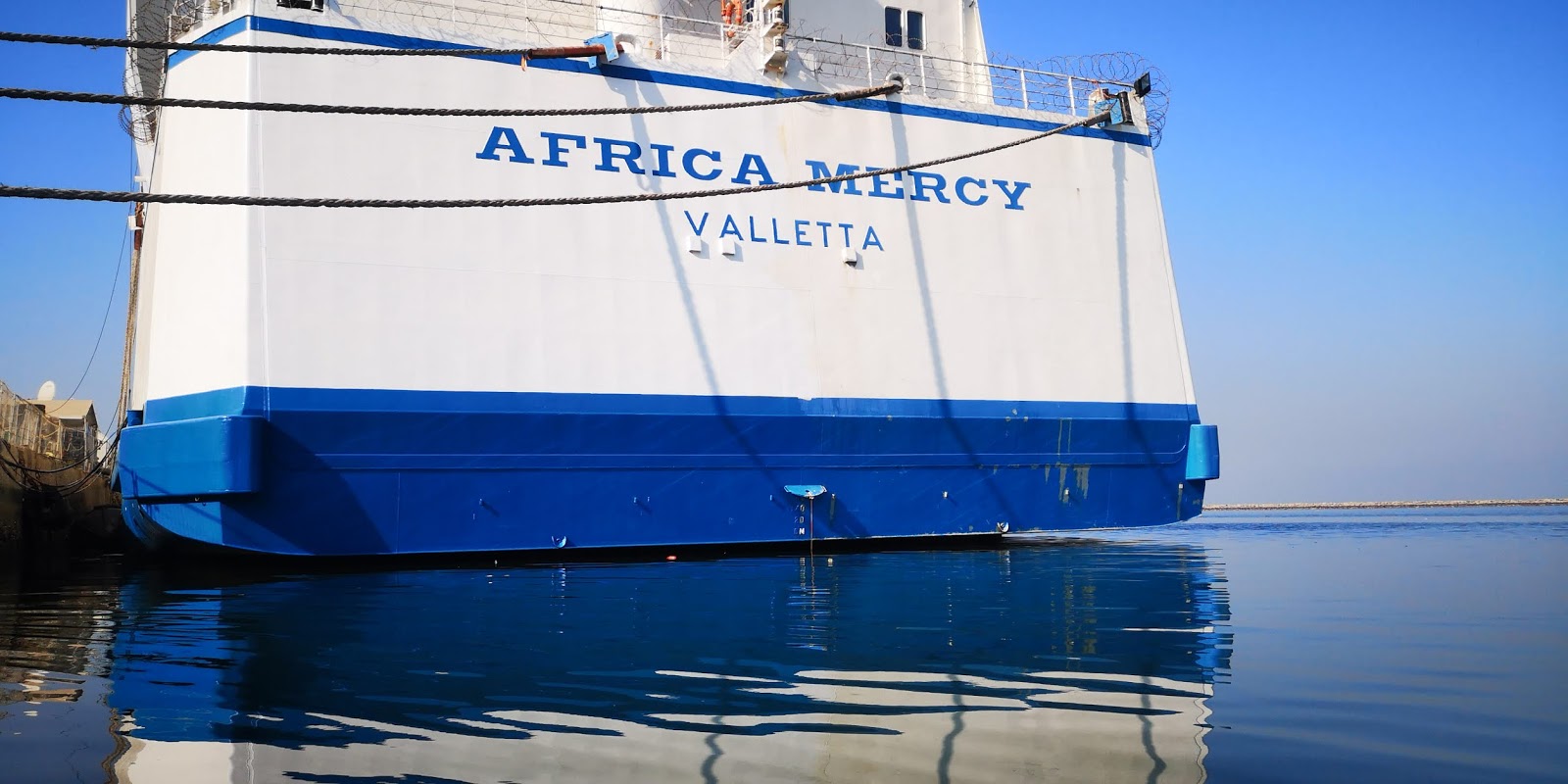
Here's a little callback to my last post (though I'm not sure how clear it is in this picture), HARMATTAN!! You can kind of see the cloud of dust obscuring the view towards the left. And you can really see the dust built up on the stern (below), where it hasn't been washed in a while.
So when you're shovelling the mountains of snow this week, just be glad you aren't inhaling the Sahara with every breath.
That's all for now. I hope to have some pictures of our cataract patients by next week.
This is my first time in West Africa during Harmattan season.
You're probably thinking, "What's this 'Hardly-a-tan?' I thought there were only 2 seasons in Africa: hot & dry, and hot & rainy." Well, surprise, surprise. Here in the Sahel region - the transition zone between the arid deserts of North Africa and the tropical forests of the south - there is an extra season. HARMATTAN.
During Harmattan, powerful winds blow across the region, bringing dusty, sand-filled air from the Sahara down into the Gulf of Guinea. The dust settles on everything and everyone, and hangs in the air like smog. In short, this:
...is Harmattan.
There are obviously many downsides to all that particulate in the air (just great on the lungs), but the one plus is that the sun doesn't beat down quite so hard as it otherwise would.
I think being right on the water helps a bit with the dryness, too.
Other than enjoying the (sometimes) cool mornings and brushing off the sand, I've had a pretty low-key week to settle in here. Due to the large cohort of new nurses, and the slow ramp-up of surgery after the Christmas break, I was kind of put on the back burner to give newer nurses a chance to learn the ropes. This meant office work and more free time than expected. Despite this, I've managed to keep myself on a half-decent sleep schedule (which, if you've ever seen me in the morning, you'll know is a minor miracle).
Now that things are back in full-swing, we've got a variety of patients filling up the wards. Kids with cataracts, adults with goiters, and both with hernias. Last week there was also another screening day up-country, where hundreds more patients were given appointments to see a surgeon.
My evening shift is starting soon, so I'd better sign off for now.
My trip here was relatively uneventful, though, as usual, I barely slept during the ~27 hours in airplanes and terminals. Weary-eyed as I was, seeing the gangway and the familiar blue lettering of the Africa Mercy was a welcome sight. The thought of lugging my duffel up said gangway was less exciting, but many hands make light work, and soon myself and the other new crew on my flight were aboard.
I am quite fortunate this year to have been placed in a two-berth cabin; most of these are reserved for couples, but there are a handful down on deck 2 with bunk-beds for singles. Deck 2 has a few drawbacks: there is a LOT of noise and heat from the engine room that it's nestled right up against, and the cabins are some of the oldest on board. There's a water pipe running from our floor to our ceiling. It's also the longest commute - a whole extra flight of stairs.
There are a lot more pros than cons, however, in my opinion. For starters, deck 2 is essentially ladies only. The ship's small gym and second-hand boutique are at the bottom of the stairs, but other than these rooms men don't really come down here. There are 2 women's washrooms with 3 bathroom and 3 shower stalls each - which are cleaned and stocked daily by housekeepers. Most of the short-term crew cabins are 6 berth, with all 6 people sharing one small bathroom/shower. As far as the noise goes, I would far rather hear the constant rumbling purr of the generators than the intermittent whoosh and clunk of the vacuum plumbing system.
All in all, I'm obviously quite lucky and pleased to have snagged this cabin. Considering how jet-lagged I was the last 2 days, I'm very, VERY glad to have such a restful space to acclimatize in. Today is the first day I haven't felt fog-brained, although I still keep waking up at 3 AM for some reason.
Terrible board game selfie with friends old and new.
It has been lovely to catch up with some old friends, but there is also a LARGE group of us nurses who just arrived - some new, some alumni - that are gearing up for another round of surgeries in the new year. The hospital was mostly shut-down over Christmas & New Years, with just 2 patients remaining with (unfortunately) infected wounds. This week is the beginning of General and Maxillo-Facial surgery, and Plastics will be starting soon after. 70 crew arrived this past weekend, about 30 of them nurses. We've had a full day of orientation, but I got to opt out of day 2 as it's been less than a year since my last service.
One of the nurse educators mentioned how the influx of such a large group of new crew is a huge asset to the work being done. We are bringing new energy and enthusiasm, hopefully boosting the spirits of all who have been here since September, or longer! As a returning crew, it is always refreshing myself to see the genuine wonder on the faces of new nurses seeing for the first time how lives are transformed here.
Looking forward to my first shift when I be a fly on the wall during some of those transformations.