Saturday, August 31, 2019

Our Boat


My journey was safe, I'm settling in, and I have been back on board our lovely AFM (Africa Mercy) for a week now. This weekend I finally have some down time to catch up on this post (which I started a while back).

It was pretty neat flying in and being able to see the line where the Sahara ends and the Sahel (transition) region begins.

^ Sub-Sahara                                                 Sahara ^

Any of you readers out there who have been following me for a while will remember that I try to do a bit of a primer on countries I'm about to visit. I've found it to be quite valuable for my own preparation - it helps me to be familiar with the culture, history, and geography of the place before I arrive. Many folks show up (especially their first time) with little to know real knowledge of the place they're in! Perhaps they prefer to learn by first-hand experience, but I've found that having a bit of awareness of the heritage and current affairs gives you a little more credibility in certain situations.

On my first visit to the AFM, in Madagascar, I had a daily fact for the entire MONTH leading up to my departure. I obviously missed the boat, *cough* so to speak, *cough* this time, but I will sprinkle some knowledge in this post.

History & Legends

There are several possible explanations as to where the name of the Senegal River, for which the country is named, originated. My favourite theory, however, is that it came from the Wolof phrase "our boat," or "Sunu Gaal." Seems rather fitting.

*breaks into song*
♪ Our ship, in the middle of our port... ♫

Speaking of Wolof... The descendants of the Wolof (or Jolof) Empire, and later Kingdom, are one of the main people groups still inhabiting the region. The founder of this empire, Ndiadiane Ndiaye, is said to have mysteriously appeared out of a lake in the midst of a fierce dispute between two rulers. Ndiadiane equitably divided the wood they were arguing over, then disappeared back into the waters. When Ndiadiane returned to settle another dispute (this time a ruse), the rulers captured him and offered him leadership of all their lands. Oh. And a hot wife. Ndiadiane took the offer, forfeiting his immortality, and all the nearby rulers gladly joined in to his new empire.


The region changed hands several times in the following centuries - during which time the trade of captured enemies as slaves became commonplace - before French colonialism took hold.

Eventually, in 1960, the Republic of Senegal became a fully independent nation, and held their first democratic election in 1963 (although there was only one presidential candidate). The nation has had a relatively peaceful and stable government since then, certainly compared to many of its neighbours.

Speaking of Neighbours...

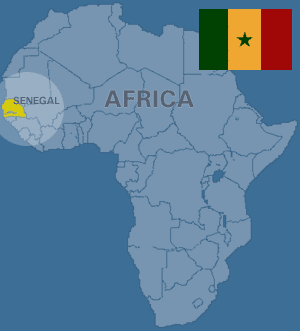
Within Senegal's borders is a most unusual country: The Gambia. This little country is a small swath of land, no more than 50 km across, which follows the Gambia river from the Atlantic coast about 300 km inland. Because it has some coast line to itself, it is considered a semi-enclave (a country contained entirely within another country). There's your fun geography fact for the day.

The Gambia holds the interesting distinction of being one of only four countries to denounce and leave the British Commonwealth, only to rejoin it later.

It's also the reason the map of Senegal reminds me of a heraldic lion.

See the resemblance?

Dakar Life

The capital of Senegal, where we are docked right now, certainly feels very different from other African cities I've visited. Sure, there are the usual wandering fruit vendors, the smell of open-air meat markets, and the lack of traffic rules. The overall vibe, however, is more touristy. There are more Europeans around, more wealthy locals, and a LOT of people jogging and working out. Not exactly something you see unless people can afford to work off extra calories. Senegal is certainly better off than most countries in West Africa - it's a tiny bit higher up the Human Development Index (164/189), and has made substantial gains in urban quality of life over the last few decades.


As you can see, they're making progress in some areas, but about 39% of the population still makes less than $2 a day.* Rural regions have fewer resources and social supports available to them, and this is why our screening teams are focusing on these remote areas. 75% of our patients will come from upcountry - these are our priority - while any referrals from here in Dakar will be put on a waiting list.
* Source: UN SDG Country Database

Our Bowl

The other day I learned about Thieboudienne or "Chebu Jen," a traditional Senegalese dish that I look forward to trying. The appeal of this dish comes not from the ingredients (it sounds like pretty standard fare - rice, fish & veg), but the way that it is served and eaten.


The large bowl is placed on the floor, where the meal is shared by all. Each person gets a wedge of the bowl, and the host divvies up the fish and veggies in the center as you go along. If that isn't the most profound metaphor for the beautiful, community-oriented culture I've come to love in Africa, I don't know what is.

Speaking of profound food....there's a pile of pulled pork calling my name right now, so I'd better sign off.

À la prochaine,
-D

Tuesday, July 30, 2019

Countdown

Well.
Now that another successful Brunch for a Cause is in the bag (huge thanks to all who attended and made it happen), I'm suddenly faced with the reality that I leave in less than a month! I had been focusing all my energies into preparing for last weekend's fundraiser, and that was my excuse for putting off other things.


I no longer have an excuse!

So, now, I'm looking around my apartment thinking about everything that needs to be packed up and stored, how I am going to decide what to take and what to leave, and thinking that packing for 9 months is going to be a bit different than packing for 2 or 3! I may not really be able to bring more things along, as my storage space on board will be the same tiny closet + 2 shelves as always. I am working on a list to ship some essentials (toiletries mainly) a few months in so I don't run out, but also don't take up too much room in the cabin.

Meanwhile, I keep tabs when I can on the current goings on aboard the ship, and with the Advance team preparing the way for us in Senegal. Here's a couple updates I thought worth sharing!

From the Advance Team

In Senegal, as we speak, and for the last few months, a team of experienced Mercy Ships volunteers has been scouting locations, shaking hands, and making all the necessary arrangements for a smooth arrival and field service. This is, as I've mentioned, the first time Mercy Ships has visited Senegal*, so it is a lot of new ground to break. We have to have written agreements covering immigration/visas, healthcare provision, local employment, transportation, and more. Speaking of employment, the HR side of things just shared that they have received a whopping 2,100 applications for day crew positions. They are currently in the middle of the interview process, and I am excited to meet the Ward Day Crew team they will end up hiring!

*Correction: The first time the Africa Mercy has visited. The first Mercy Ship, the Anastasis, carried out a 4-month field service in Senegal back in 1993.

From Shipyard

The Africa Mercy has spent the past couple months getting sanded, blasted, upgraded, repaired, parts replaced, old carpet torn out and new hardwood put down, and a shiny new paint job to boot. It has just gotten out of dry dock and back into the water, and will be very soon departing the Canary Islands to set sail down the coast to Dakar! 

10 months of wear & tear
2 months of R&R (repairs & restoration)!
I suppose this has been enough procrastination now, and I must get some things done around here!
Thank you all for standing along side me in this journey.

À la prochaine,
-D

Tuesday, July 23, 2019

Every Sound of the Drum

Just came across this incredible music video that summarizes the history of both West African music in general, and Senegal itself. It's dated, and cheesy, and there's reggae-style rap - and I love it a lot. Stick around 'till the last minute for the history lesson. It does a far better job than I would likely have done in my not-yet-written post about the country.


I really can't top that.

Now watch this - and hope to see you on Saturday!


-D

Thursday, July 4, 2019

Art Attack


Life always seems to get ahead of me when I'm at home, and it's harder to find time to sit down and write. I actually started this post back in May, and I'm only just getting around to finishing it. Sorry.
So I guess that means it's time for:

A quick update!

Mercy Ships Canada has changed their donation system, meaning my donation page has changed.
It can now be found HERE, or tinyurl.com/crewmate2 also works if you'd like something short and easy to share.

A few items of thanks

I'm fortunate enough to have very flexible landlords who have arranged a short-term sublet of my furnished apartment while I am away, meaning I only have to pack and store my personal items. Most of my larger belongings can hang tight right where they are.

I had a little money that carried over from last year's fundraising, and a few new donations came in; just enough to book my flights to Senegal. I now need only cover my costs for monthly crew fees.

My wonderful parents, and good friends Rob & Sue are already getting the ball rolling on our (now) traditional brunch fundraiser. I'm so grateful for their eagerness to support me, and seemingly boundless energy! PS IT'LL BE JULY 27TH SO BE THERE AND GET FED.


Now that that's over with...

On with the post!

The Africa Mercy is a pretty neat ship - granted, I haven't been on that many ships - but I suspect it has a fairly unique list of ports of call compared to your average passenger liner. In its journeys, from its time as a Danish train ferry to its current life as a hospital ship, it has visited a good chunk of the world. Serving in this particular part of the world, where culture is as deep and rich as the red sands of the roads, that culture has rubbed off on the AFM (and I don't just mean the harmattan dust).

There is a veritable smorgasbord of (mostly) West African art adorning the walls and corridors, many of them gifts of gratitude, from the nations where the ship has served. Since I'm currently just hanging out at home with not much news to share, I thought this would be a fun little filler post to bide us over. Therefore, I shall now shut up and let the art (and a few quotes from everyone's favourite painter) take over from here. Click on any pic to embiggen.

“You have to allow the paint to break to make it beautiful.” ― Bob Ross

 “We don’t laugh because we feel good, we feel good because we laugh.” ― Bob Ross

“It’s hard to see things when you are too close. Take a step back and look.” ― Bob Ross
Whoops! How did that get in there...hardly fair comparing this to canvas and paint.

“You can do anything here — the only prerequisite is that it makes you happy.” ― Bob Ross


“Go out on limb. That’s where the fruit is.” ― Bob Ross


Left: plaque showing the outreach locations teams reached from the ship's location in Tamatave, Madagascar.

Right: One of several statues gifted by the leadership of Benin. Its attire was not exactly..."family friendly." Thus the addition of a little tube top.


Well, that's about all I was able to capture back in March. Hope it gave you an idea what it's like to stroll around the AFM, and the rich and vibrant places it has visited. À la prochaine...


- D

Wednesday, March 13, 2019

Tantrums & Tibias

Patient "A" (for the sake of this, let's call him 'Andy') was one of a handful of patients in the hospital when I arrived in January. He had had surgery for his bowed legs back in December, but had some unexpected complications which kept him stuck on the ward over the Christmas break. Our team of hospital physicians were initially mystified by his unexplained fevers, but eventually their research, and some test results, gave us a clue as to what was going on.

He was becoming severely neutropenic - his white blood cell counts were far below normal. Essentially, his immune system was compromised for some reason. He had been perfectly fine before surgery; this is something we routinely check for a pre-op baseline. The only explanation our docs could come up with was that it was an uncommon and drastic reaction to a particular antibiotic he had been given. In digging a little myself, I could only find 3 or 4 similar cases mentioned in published literature. As soon as the link was made the antibiotics were stopped, but it took weeks for his system to recover. 


Weeks during which he had to be "reverse isolated:" anyone caring for him had to gown and mask up, he couldn't have visitors, and we kept his side of the ward empty aside from him and his mother. If he left the ward, HE had to wear a mask. Any mild infection could have wreaked havoc while he was so compromised, and he still had an open wound on his leg which was taking its jolly time to heal. He still had casts on both legs, one of which was split so we could access his wound, then wrap it back up tightly together. Because of the risk of infection and his delayed wound healing, "Andy" wasn't nearly as mobile as he should have been this long after surgery. This was causing even more delays in his bone healing. 

WARNING - MILDLY ICKY MEDICAL STUFF IN THIS PARAGRAPH 
I haven't ever talked about our Ortho specialty much because I haven't seen much of it myself - so I'll explain a little what goes on. Most patients we see have a congenital condition that worsens as they grow older, and can become astoundingly severe in our older patients. By older, I mean teenagers. Kids' bones are different than an adult's; they're still growing, and they heal faster. Correcting these windswept or bowed legs requires cutting the bones, over-correcting the deformity, casting them in position then getting the kids to walk. That's the hard part. The weight and pressure from walking actually brings the fragmented bones together. It is a much more complicated and less successful process for adults, which is why our Ortho service is almost exclusively pediatric. Kids' bones have a little bit of give to them, which is why the Ponseti Method works so well to fix club feet. 

ICKY STUFF DONE! 

All this is to say...'Andy' had a rough go of it. He had painful, daily dressing changes, walking was still hurting a lot, and for a few weeks we couldn't even give him a high-five without putting on gloves. The first shift I looked after him, he was absolutely INCONSOLABLE when he saw me getting pain meds for his dressing change. Literally screaming and flailing his arms. His mother wouldn't make eye contact with me as I tried to indicate she should try to help calm him down. She sat, staring at the floor, as tears streamed down her son's face. I was bewildered, and my translator seemed bemused, but we did manage to get the meds into him. After a bit more wailing as I started the dressing, 'Andy' calmed down, distracted by some games on an iPad while I worked. A while later, when another translator was free, I was able to talk to the mother and get a better grasp on the situation. 

Numerous tests had been done over the previous few days, and no one had really told her the results. It had been the weekend, the Orthopedic surgeon was gone, and likely everyone assumed someone else had already explained. It's also possible there was no translator available for her language. The mother, as a result, had assumed the worst she could imagine. Communication mishaps happen enough when there isn't a language barrier. It's so much more likely in this situation. To make a long story short, I was able to reassure the mother, our lovely Dr. Laura also came by to explain the test results in more detail, and mother was much happier - and much more helpful with meds and procedures. And she was always fastidious about hand hygiene, pumping dollops of purell onto her son's hands for him. 

'Andy' remained a bit - how shall I say - moody? He could be your best pal one day then glaring and brooding the next. But I suppose that can be par for the course with a teenager. 

THIS WAS A BROODING DAY. 

THIS WAS A GOOD DAY. 
 

Eventually, as expected, his test results improved enough that we could stop with the reverse iso precautions, and his wound began to heal, albeit slowly. Out of nowhere, too, he got a sudden burst of motivation. He went from refusing to walk the length of the corridor to kicking around a soccer ball and CLIMBING STAIRS a few days later. 


I think the chance to see the bridge was pretty good incentive - big props to Captain Milo for making that happen. 


I didn't see 'Andy' much over the last few weeks before I left, as he was out at the HOPE Center and only coming by for dressing changes and rehab a couple times a week. But I heard from colleagues that his wound is nearly closed, and he's not letting much hold him back now.

The long-awaited day of discharge from the hospital!

Á la prochaine,
-D

Wednesday, March 6, 2019

Airborne

My time in Guinea has ended, and boy did it go out with a bang.

My last few shifts were...surprising - I think is the best word. 

I started working some shifts as a charge nurse this year. I was a tad apprehensive at first, but after some orientation and a couple shifts under my belt, I felt fairly comfortable about it. I had already completed the 4 charge shifts that were on my schedule, but I ended up trading to help someone out and was in charge again Tuesday evening. 

EVENING ONE - SPORTBALL 

The shift went by without much excitement until about 8:30, when a nurse asked me to look at her hernia patient. "There's a LOT more swelling than there was." In about half an hour, he had gained a softball-sized bulge that was definitely not there before. I paged the surgeon, who came down to look and wrote orders to take the patient back to the OR in the morning. He was bleeding, but it wasn't severe enough to warrant surgery that night. Page back if it gets to be football-sized. Ok, that's what we'll do, I guess. I let the OR team know, got a consent signed, and checked in with the team leader to make sure I hadn't missed anything important. 

Apparently I didn't notice that I had been sweating buckets even just sitting at the computer, because it's HOT in our ward, and a nice little dizzy spell forced me to take a breather and remember to drink water. One of the night shift nurses had made pies, so I got a piece and moved to the air-conditioned office to finish up my work. By the time I updated all the paperwork for the morning shift, I's dotted and T's crossed, I finally left - a round midnight. Slightly uneasy about the still-slowly-bleeding patient, it was even later by the time I fell asleep. No bother, I could sleep in. 

EVENING TWO - DÉJÀ VU 

Arriving on the ward, my team leader said, "Surprise! We need you in charge again!" No problem, I handled last night, and it can't be as crazy as that again. 
The bleeder from yesterday was doing fine, and everything was run of the mill until about 9; shortly after the surgeons had done their rounds. "My kid in bed 1 suddenly has all this swelling." You're kidding me. Paged the surgeon, he took one look and asked, "When did he last eat?" Great. Needs to go back to OR tonight. Once again, notified the OR team, consent, paperwork, find a translator that can explain everything to mama, and he's whisked out of the ward before shift change at 10. 

Just as I'm bringing my print-outs for the morning shift back from the office, around 11, the phone rings. "That was quick," I think as I answer, expecting the news that they're bringing him back out of recovery. 
It's the OR nurse, Melissa. "Did the day nurse say anything to you about a blistery rash?" 
"Wha...?" I double check with the night nurse who got report. "No, no one saw anything..." 
"We THINK he might have Chicken Pox." 
No freaking way. After a moment's disbelief, we discuss what to do and I jog down to D ward to make sure there's an isolation room free. The doctor on call needs to verify before we can do anything - it's a sweet English lady who usually works ashore in Capacity Building. She's never been in the OR and I help her gown up and direct her to the recovery room. "This is what I get for offering to cover the pager," she jokes. 

Sure enough, she's 99% sure it's Varicella. We have to isolate. Once again I track down a Mandingo speaker to explain everything to mum, and escort her to the iso room. It's full of extra ICU equipment which we hurriedly haul out of the way. Shortly after, her son arrives in Melissa's arms, and I help the night nurse get him settled in bed. It's after midnight by now, and our infection control nurse turns up (bless her). We all chat about the plan, no, it's not ideal, we don't have a negative pressure room, but it should be ok, it's more droplets that we need to worry about, they SHOULD be able to go home in the morning. 

Around 1 AM, at the insistance from the night nurse that she would manage (despite having this patient plus 8 more in a different ward), I went off to bed. 

EVENING THREE - MISGIVINGS 

My last shift before I head home. I'm not in charge. Phew. I'll just manage my patient load, no surprises, no problem. Right? Heh. There's some acute patients in D ward, so they've borrowed some of our staff, leaving us with 6 patients each. One of mine is our chicken pox patient. They're from upcountry, and need to stay close by until their 1 week follow-up appointment. We can't send them back to the HOPE center - he's still contagious. Mama doesn't know anyone in Conakry she can stay with, so we're going to try to put them up in a hotel. 

Going back and forth between iso and A Ward (opposite ends of the hospital), I'm trying to get myself organized and make sure I've checked on all my patients when Lizzie, the infection control nurse, tells me they've organized a place for our pox patient to stay. "I've still got to do some teaching," I tell her; she's going to come back with a chaplain who can translate for us.

After about an hour explaining the plan to mama, making sure she understands the medications and can open the stupid child-proof bottles (that is not as easy as you might think to explain in a different language), we finally started to head out. Mama stopped short outside the door and said something to the chaplain. "She wants you to pray for her," he tells me.

"Me? Are you sure? In English? Would she prefer you pray in Mandingo?"

They converse a little, and he says, "Yes, you pray, I will translate."

I don't know what that mama believes, but in that moment she knew she needed someone greater than her to get her through the week ahead. Lizzie later shared that when they reached the hotel, Mama was pleading that they not leave her there. She had lived her whole life in a remote, rural area; being in a huge city like Conakry was terrifying to her. At the HOPE center there are translators and other patients from all over the country; there's always someone you can talk to. It's safe, secure, and familiar. 

She did not want to be alone.

Lizzie and Christopher, the chaplain, were able to find a staff member at the hotel who could speak Mandingo, they helped settle mama in, reassured her that staff from the HOPE center would see her every day to bring meals, and gave her an emergency contact number. It sounds like by the time they left she was more at ease. 
~ ~ ~
Once the two of them were off in Lizzie's capable hands, I rushed back over to A Ward, where I had left a fresh post-op patient for far, far too long.  "Your vitals are done, and I gave bed 7 his paracetamol." My fellow nurses are rock stars. 

I again was in the hospital till after midnight, cleaning the iso room from floor to ceiling with my charge nurse's help. 

~ ~ ~
I don't think I'd trade those 3 crazy shifts for any one shift here at home. They were stressful, but I still walked away feeling fulfilled, effective, and oh so appreciative for the professional team who, despite being from different countries and speaking different languages, work so well together to share the load and show our patients love. 

I'll miss you Guinea,
And you too AFM - but I'll be climbing back up the gangway before long.


À la prochaine,
-D

Friday, February 15, 2019

Sene-Gal

Whelp, I'm officially signed on to serve for the entirety of the Africa Mercy's field service in Dakar, Senegal; for nine months, give or take.


I was able to post a bit more frequently in January, as the hospital wasn't very full, but now we're overflowing (literally: we're opening our small, overflow ward next week)! I've thus been working a good deal more and haven't had much time for a "life admin" day where I could blog and catch up on email. The email that appeared 2 days ago from the Mercy Ships Senior Staffing Manager, though, warranted some reflection and careful consideration.

I have felt a pull to commit to a longer service here on board for some time now, and I finally realized I could keep coming up with excuses to put it off for ages and ages if I didn't get my act together and jump for it. It was a bit like working up the gumption to jump from a high cliff into the water below; you know the water's deep enough, you know you'll have enough breath to make it back up to the surface, but pushing off that solid rock beneath your feet is still hard to commit to. I'm particularly bad at this...I will stand up there for 10 minutes thinking about jumping before I manage it. So I knew I needed to stop waiting for a sign or some perfect sequence of events to align, and just DO IT already.


OK OK OK - Doing it.

So, now my mind is racing with all the things I'm going to have to organize between now and then - and I'm still here! Trying to focus on the present and our patients. Thyroid surgery wraps up today (sure saw some incredibly huge goiters), and we'll be back into hernias and lipomas. With a side of burn contracture releases - their grafts take a few weeks of TLC and close monitoring before we can send them off-ship, so quite a few of them are hanging out with us.

All our goiter patients with the screening team - the seated lady on the far right had the largest by far! 

Our plastic surgery patients, in particular, require a lot of extra protein and calories to build lots of happy, healthy tissue over their graft sites. So this has pretty much been the non-thyroid side of our ward the past few weeks:

Those packets are a peanut-based supplement that we make into milkshakes and...gently coax our patients into drinking.


A few weeks ago we also had a run of cranio-facial surgery; this little champ had an encephalocele - a birth defect where skull development is incomplete and part of the brain tissue ends up outside the skull. It's slightly terrifying yet awe-inspiring that we are able to perform such a complex surgery here, and quite successfully. Fortunately we have some great specialists, including neurosurgery nurses, who were able to manage the many delicate tubes and beeping machines keeping these little ones stable while they recovered. The odds of surviving to adulthood with an encephalocele are about 50/50 - so it's pretty exciting we could change the odds for each of these little ones.

Back to Senegal though...

This will be Mercy Ships' first field service in Senegal - but not their first visit! The AFM made a stop-over last year to briefly meet & greet the local authorities whose collaboration and support is key to making the field service a success.

As I've said in the past, there is an insane amount of preparation and work that goes on behind the scenes, years before a field service even begins.


Senegal is, evidently, significantly better-off than Guinea. Like most countries in this region, however, lack of infrastructure and development in rural areas is a problem. Those living far away from the capitol city of Dakar, where many health services are available, are fresh out of luck. An excerpt from the Advance Team's assessment:
"Regarding surgeon to patient ratio, there are not enough surgeons for the amount of patients needing surgery, which causes a backlog of patients. This backlog is also increased by the cost of surgery. Skills are not necessarily lacking, especially in Dakar, but surgeons are overwhelmed."
This backlog means that the few professionals that are around are so overworked they rarely have the opportunity for professional development. In a profession that is so constantly changing, ongoing education is essential. Mentoring and training will therefore be a key part of the field service, in addition to relieving some of their surgical caseload.

Alright, I think I've rambled long enough, and dinner is calling my name.

À la prochaine,
-D