Monday, January 23, 2017

It's all Fon & Games...

Ready for some learning? Strap on your thinking caps!


While the official language of Benin is French (génial! Je l'ai pratiqué!), a large portion of the population primarily speak other indigenous languages, including Fon and Yarouba.

The Fon people group make up the majority of southern Benin, and their language has its own alphabet:
GBETA GBƐ Ɔ BI TƆN EE ƉƆ XÓ DÓ ACƐ E GBƐTƆ ƉÓ KPODO SISI E ƉO NA ƉÓ N'I LƐ KPO WU E WEXWLE
The Fon language (or Fongbe) is also a TONAL language, meaning that the same sound can have a different meaning if spoken in a high tone or a low tone.
*gulp*


For now, I'll just stick with the basics and fall back to my bumbling French.


Yes = "Eeen"
No = "Eho"


In my experience, these two words can get you through almost any pushy market negotiation. Numbers help with that too:

Dokbo, we, aton, ene, atoon, aizen, ten-we, tan-ton, ten-ene, woO!


I like number ten. WOO! Though unfortunately, in my experience in Madagascar anyway, people tend to revert to French whenever using numbers.

Hello = Mi Kwabo
Thank you very much = A houanu kaka
White person = Yovo


I can't figure out if the "kaka" part is "thank you" or "very much"...so I guess I'll be the stupid Yovo wandering around the streets yelling, "KAKA!" to people all the time. 

I believe, "Gbo se a!" is the Fon equivalent of "Azafady" (Malagasy for "sorry/excuse me"). I fully expect everyone on the ship to still say Azafady all the time, though. It really becomes an ingrained habit!

The other language that is fairly common in the region is Yorouba, a language which originates in Nigeria. The modern written form of Yoruba was actually developed by missionaries while translating the first Yoruba bible.


Some basic Yoruba:

Hello =Ẹ n lẹ
Yes = Bẹẹ ni
No = Bẹẹ kọ
Sorry = Pẹlẹ
My hovercraft is full of eels = Ọkọ afategun-sare mi kun fun ẹja arọ


Well, I think that's all I'll ever need to know, right?

In other news, my departure date is a month away! I am close, but not quite at my fundraising goal, so my parents & some friends have offered to put on a fundraising brunch in Peterborough! Here's the deets:


Dogbe (goodnight) for now!

Wednesday, January 11, 2017

Departures

Sorry for (yet another) long absence. I feel I am always apologizing for that, but this time I was REALLY overdue. I feel like I should explain why, and get some things off my chest in the process. (Warning, this post is going to be a bit different than most. It might get a bit personal...and not really about Benin. So if you're just here for Benin/Ship stuff, feel free to skip this post!).

 I lost some family in the past month.

 My grandfather passed away in early December. This was, in many ways, a blessing, as he had been unwell for some months how, having lost much of his function to a stroke. They had also found some cancer in his bowel. Thus, it was not a matter of if, but when.


As I try to find the words to describe my grandpa "Sam," I hesitate. It is hard to do so without sounding calloused. As my cousin put it at the funeral, our grandpa was not the kind of rosy-cheeked hug-able grandpa who lets you sit in his lap and sneaks you cookies. He was fairly the opposite, in fact. He always spoke his mind; he could be harsh, even cruel, if you disagreed with him. His sharp tongue was his greatest tool.

It was not the only tool he wielded, though. He taught my dad how to fish, how to hunt; he even helped him build our home in North Bay. He was a masterful craftsman. He left us all with beautiful pieces of furniture, a part of him left behind in my home which speaks more love to me than he ever said out loud. And as he passed these skills on to my dad, my dad has also passed many of them on to me. When I share those moments with my dad, I'm indirectly sharing a moment with Gramps too. Grandpa had a tough-as-nails exterior, and a few even tougher layers beneath that. But deep down, if you could peel back those layers, there was a soft heart in there somewhere. He tried to hide it, but it was certainly there.

The hardest part of losing him was not knowing the state of his heart, which was so hard to get to. He would speak with disdain of how my dad "went all religious." I still hold on to a sliver of hope that the love and forgiveness we tried to show him somehow found its way through all the layers to where it mattered.

 Just before New Years, I lost part of a different family.

Henry was one of my classmates at Summit, which I still consider to be one of the most important formative experiences of my life. In this year full of extreme outdoor sports, Henry was a bit of a fish out of water. A missionary kid who'd spent most of his life in Uganda, he could be socially awkward, and didn't have much of a knack for the kinetics of paddling and climbing. He was very analytical and technically minded, though, and always wanted to understand the "why" before learning the "how." Summit was the tightest group of friends I've ever been a part of. We trusted each other implicitly, and grew to be more than a community, but truly a family. When asked how he got that to happen, Kai (the director of Summit) said, "Easy. I just get them to risk their lives together" (I should add that we literally signed a waver on serious maiming and death on our first day). When you've literally entrusted your safety, indeed your life, to another person (and vice versa), it creates a trust and bond that's hard to describe.

That's me on the left there, with Henry backing me up. His comment on this photo: "Considering I'm holding
a person's life and health on the other end of that rope, I look remarkably perky, don't I?" 
Henry was the gentle giant of our Summit family. Both of us being night owls, we spent many a late night up in the library discussing life, God, and sometimes the sci-fi/fantasy stories we shared a love for. I am heartbroken that he's gone, and heartbroken for his family. A little smile comes to my face, however, when I imagine what he must be doing now.


So, I've been processing all that over the past month. And I'm sorry for rambling, but I feel like I needed to take the time to acknowledge their lives, and the important roles they had in mine.

If you made it this far, thanks for taking the time too.

Now, as my departure date approaches (only 7 weeks! Holy smokes!), I promise I will be updating more faithfully from now on, and can't wait to learn more about Benin together!

Wednesday, November 9, 2016

Smile

In the midst of the firestorm that is going on right now...I felt I needed a bit of writing therapy to clear my head.

This morning, I scrolled through my internet feeds and read an unending stream of fear, disbelief, and panic.

MFW I woke up this morning
At first, my brain didn't know how to process this. I kept trying to convince myself there is still some contingency, some chance that someone will pop out with a camera and tell us this whole election was all just a big prank!


After a few minutes of this...I was starting to get to this point:


When I finally got up to eat a cookie, I had a realization. The challenges facing the US right now are substantial, but they are NOTHING compared to the challenges faced by every single person living in rural sub-Saharan Africa every day.

If I had grown up in rural Benin:

Many of my ancestors would have been sold to slavers and taken to the Americas.
The year I was born, protests sparked a change in the democratic process, leading to the first multi-party elections.
I had a 1 in 10 chance of dying before the age of 5.
I likely wouldn't have had a safe source of drinking water.
My community would have open sewers, if sewers at all.
I had a 50/50 chance of being orphaned.
I had a 50/50 chance of being used for child labour.
7 in 10 girls my age are illiterate.
I would earn ~$1.25 USD a day.
I would have a 1 in 53 chance of dying in childbirth during my lifetime.
I would have a mobile phone, but no access to the internet.
My country remains one of the world's poorest countries.
Although my government is relatively stable, it is rife with corruption.
My taxes are likely collected by men with rifles.

So before we get to this point:


...whatever your political opinions, let's just try to get past this turmoil as quickly as possible and get  back to doing everything we can to change the shape of things to come.

You can't fight fire with fire.

And in the mean time, if you need some cheering up, watch this.

Thursday, October 20, 2016

Mosquitos Suck.

Mosquitoes suck. The biggest cause of death in the developing world is Malaria, and it's really all the mosquitoes' fault. They LITERALLY suck.


Whoa now, Captain. Take it easy. Mosquitoes actually DO literally suck. Although it's not just the sucking that sucks. It's the...reverse...um...ok. Hold on here. Let's just illustrate since I can't talk.

So, you see, the mosquitoes suck, but while they're sucking, the malaria parasites get un-sucked. :/

Anyway, I think most people are probably fairly familiar with the fact that malaria is transmitted by mosquitoes. This fact actually makes mosquitoes the deadliest animals in the world.

Once in the bloodstream, the parasites proceed to the liver, where they mature & multiply for a bit, then proceed to infect and destroy the host's red blood cells. Eventually, the destruction of blood cells causes multiple organ failure, and, if untreated, death.

Infected red blood cells

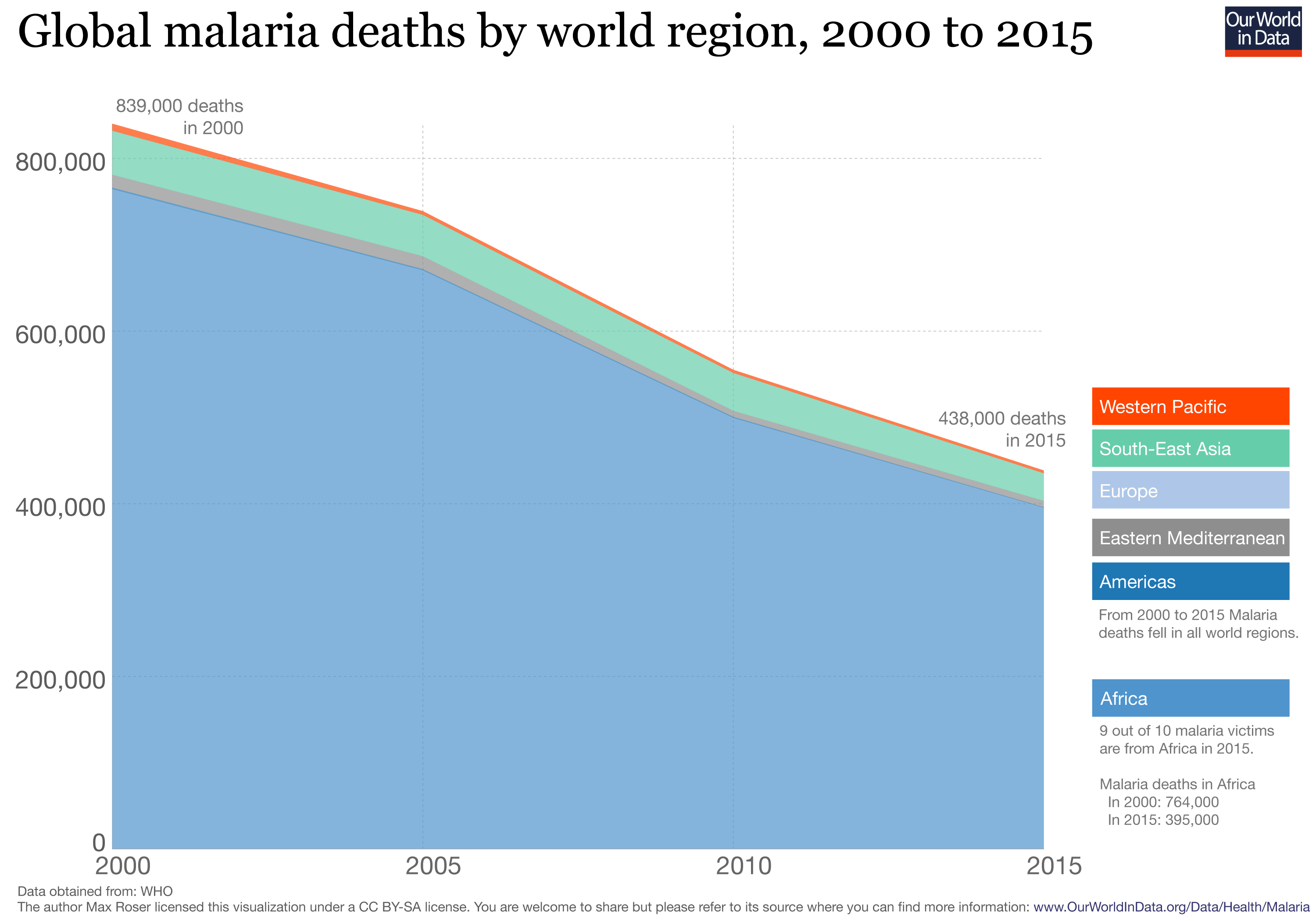
Last year, there were 438,000 deaths from malaria*. That's 1200 deaths a day. Most of these were in sub-saharan Africa, and most were children under the age of 5.

In Benin, there were at least 2 million cases of malaria, and an estimated 4400-8000 deaths in 2013*. The numbers are not well defined, as many cases occur in rural areas; they're never tested, treated, or directly confirmed.

The good news is, malaria rates are falling tremendously, thanks to the hard work of many NGO's in providing education, mosquito nets, pesticides, and other methods of mosquito population control. Malaria is also reasonably easy to treat, when it is caught early.


The bad news is, many deaths still occur when the disease is not detected, and when proper care and treatment is out of reach. In some areas as well, parasites have been found with resistance to some anti-malarial medications. This is a scary prospect.

So what can we do about it?

Well, here's a slightly scary, but potentially perfect solution. Something to chew on.


*WHO, 2015
*WHO, 2013 


Monday, October 10, 2016

On Pins & Needles

Well. That was a longer break than I expected. The last 2 months have been incredibly busy; I think I worked more shifts in September than I've ever worked in 1 month. I had a roommate move out, and a new one move in. Summer ended as quick as it hit. I wrote this blog post, and lost it...so I'm now completely re-writing it. But at least it's not 35 degrees outside, so I've got that going for me.

I love fall.
So, to make up for my extended absence, I'm resuming with a rather juicy subject.


The practice known as Voodoo in the Americas originated in west Africa as the "Vodun" religion. Vodun is primarily practiced by the Fon, Ewe, and other small people groups around southern Togo and Benin. Slaves carried the practices over to the Caribbean islands, and although the current practices do bear similarities, they have evolved separately over the years. Both have incorporated elements of other religions, including Christianity. Many in Benin practice a blend of traditional beliefs and Christianity. 


So. Vodun practices believe in a creator goddess named Mawu. She, and a pantheon of other gods, are believed to give all natural things divine power. Thus, many items such as herbs, animal parts, and carved talismans are considered sacred. These items are known as "fetishes," and are used in rituals to communicate with dead ancestors, or sometimes for benefit or for harm.


West African Vodun primarily focuses on the connection with the dead; similar to Malagasy traditional beliefs, it is common to ask an ancestor to intercede with the gods on one's behalf.

These fetishes are spiked so they can be driven into the ground and connect with the spirits of the earth.
Vodun priests may sometimes request payment for services or atonement for an offence. This payment could often take the form of a virgin daughter, who was given as a slave to the priests of the shrine. She was considered a "wife of the gods," and as such, her body was forfeit to the whims of the priests to the gods. This practice was outlawed only in the late 90's, and while it now carries a hefty penalty, it has not fully stopped the practice in some areas of Ghana. 


A number of NGOs are working to free women from this horrific system, among them UNICEF and Every Child Ministry. Check them out.

Sorry, again, for the extended period of silence! My fall schedule (for now) does appear to be much less hectic, so I should be better from now on.

Other news:
I'm now 100% free of debt! Woooo! Very exciting times. This is particularly exciting for me because it means I now feel free to think about some longer term service opportunities in the future.

But for now, I'll just focus on Benin.

Till next time,
-D

Friday, August 12, 2016

Where We're Going...We Need Roads.

In Benin, as of 2010, there were 5.9 physicians for every 100,000 people.

That's about the population of the county of Peterborough, that I live in. That is pretty hard to grasp. A community of this size being served by only 5-6 physicians. And we complain about 4 hour wait times in the ER. My hospital alone has over 370 physicians. Benin has less than 600 physicians in the ENTIRE COUNTRY.


Infrastructure is certainly a major barrier in access to healthcare in developing nations, as I heard first hand in Madagascar. People would often walk for days to reach a screening centre or the ship itself. Ensuring that public health information and vaccines can saturate even the most remote populations is an incredible challenge, when the "roads" look like this.


Improving the country's infrastructure is a huge step in better overall public health and better access to care, but having a better road isn't going to help if there aren't any doctors to see. Part of the challenge is also a hesitance to utilize the resources that are available, and instead relying on traditional Vodun (voodoo) methods. But more on that in a later post.

Benin is working to improve the healthcare situation, with policies in place to improve health coverage and education, and is receiving assistance from many NGOs in this regard.

This is why an emphasis of Mercy Ships' work is to have a "lasting impact" - through training workshops, mentoring opportunities, and improvements to local facilities. These programs help equip the country to continue the work of transformative surgery long after the ship has gone.


Exhibit C - In which my pasty whiteness has never been more evident.

In Other News...

After a great week at camp, I got sick. Of course. Can't visit camp without picking up the Campititis. After a week of hoping these knives in my throat would just decide to go away, I finally gave up and visited the walk-in clinic for some antibiotics...from one of my cities HUNDREDS of doctors. Boy, how easy it is to forget how fortunate we are. 

Also, officially booked my flights today! And that's a big chunk out of the bank. But it's also nice to have it said and done, so I can focus on saving for other things.

One other piece of good news, I have found a roommate for the fall, which is a BIG help in that whole money-saving business.

TTYNW (talk to you next week)!

Sunday, July 31, 2016

The measure of His purpose

Ok. We've talked a bit about the history of Benin, now let's talk about the present.

Benin's current population is just under 11 million. That's about 1/3 of the population of Canada.
Like Canada, most of the population of Benin live along the southern border, which, in this case, is the coast of the Atlantic. Not surprising, considering the major role the Atlantic slave trade played in the country's development. Most of the country's cities and infrastructure lie in the south, while the northern highland/mountain regions are much more rural and undeveloped. In the very far north, spilling into Burkina Faso and Niger, are two large wildlife reserves. These are home to many of the endangered animals I mentioned a few weeks ago, and although they are considered a dangerous region for foreigners to visit, they do provide some of the country's tourism.


Although it is one of the most politically stable countries in the region, Benin still ranks extremely low on the UN's Human Development Index, which takes into account education, gender equality, quality of life, and life expectancy. Economically the country is growing, life expectancy and education have increased dramatically over the last 35 years, but it is still very, very far behind the rest of the world, ranking 166th out of 188 countries. The gender gap in education remains quite wide, with boys on average attending school twice as long as girls.

37% of the population of Benin still lives in severe poverty.

In future posts, I'll be delving deeper into some of these numbers. Mainly, the state of healthcare, access to education, and gender disparity in Benin. To give you some background, check out this video about the UN's Sustainable Development Goals. It will help you understand the progress that has been made over the past few years, how that progress is measured, and what we must do to further that progress.


"To understand God's thoughts we must study statistics, 

for these are the measure of His purpose."

-Florence Nightingale


Progress Updates:

Good news! I don't have Tuberculosis! My test came back clear. *phew*

Also, because of some communication delays, I ended up getting set up with a much better deal for my flights - $500 less than my original plan! Hooray for awesome Anabaptist travel agents!

Finally, my donation page is now up and running! If you feel inclined to help support me financially during my time serving with Mercy Ships, you can now do so HERE. If you feel inclined to support me through encouragement, prayer, songs, or...um...interpretive dance... I'll appreciate that too.

Till next week!
-D