Monday, October 10, 2016

On Pins & Needles

Well. That was a longer break than I expected. The last 2 months have been incredibly busy; I think I worked more shifts in September than I've ever worked in 1 month. I had a roommate move out, and a new one move in. Summer ended as quick as it hit. I wrote this blog post, and lost it...so I'm now completely re-writing it. But at least it's not 35 degrees outside, so I've got that going for me.

I love fall.
So, to make up for my extended absence, I'm resuming with a rather juicy subject.


The practice known as Voodoo in the Americas originated in west Africa as the "Vodun" religion. Vodun is primarily practiced by the Fon, Ewe, and other small people groups around southern Togo and Benin. Slaves carried the practices over to the Caribbean islands, and although the current practices do bear similarities, they have evolved separately over the years. Both have incorporated elements of other religions, including Christianity. Many in Benin practice a blend of traditional beliefs and Christianity. 


So. Vodun practices believe in a creator goddess named Mawu. She, and a pantheon of other gods, are believed to give all natural things divine power. Thus, many items such as herbs, animal parts, and carved talismans are considered sacred. These items are known as "fetishes," and are used in rituals to communicate with dead ancestors, or sometimes for benefit or for harm.


West African Vodun primarily focuses on the connection with the dead; similar to Malagasy traditional beliefs, it is common to ask an ancestor to intercede with the gods on one's behalf.

These fetishes are spiked so they can be driven into the ground and connect with the spirits of the earth.
Vodun priests may sometimes request payment for services or atonement for an offence. This payment could often take the form of a virgin daughter, who was given as a slave to the priests of the shrine. She was considered a "wife of the gods," and as such, her body was forfeit to the whims of the priests to the gods. This practice was outlawed only in the late 90's, and while it now carries a hefty penalty, it has not fully stopped the practice in some areas of Ghana. 


A number of NGOs are working to free women from this horrific system, among them UNICEF and Every Child Ministry. Check them out.

Sorry, again, for the extended period of silence! My fall schedule (for now) does appear to be much less hectic, so I should be better from now on.

Other news:
I'm now 100% free of debt! Woooo! Very exciting times. This is particularly exciting for me because it means I now feel free to think about some longer term service opportunities in the future.

But for now, I'll just focus on Benin.

Till next time,
-D

Friday, August 12, 2016

Where We're Going...We Need Roads.

In Benin, as of 2010, there were 5.9 physicians for every 100,000 people.

That's about the population of the county of Peterborough, that I live in. That is pretty hard to grasp. A community of this size being served by only 5-6 physicians. And we complain about 4 hour wait times in the ER. My hospital alone has over 370 physicians. Benin has less than 600 physicians in the ENTIRE COUNTRY.


Infrastructure is certainly a major barrier in access to healthcare in developing nations, as I heard first hand in Madagascar. People would often walk for days to reach a screening centre or the ship itself. Ensuring that public health information and vaccines can saturate even the most remote populations is an incredible challenge, when the "roads" look like this.


Improving the country's infrastructure is a huge step in better overall public health and better access to care, but having a better road isn't going to help if there aren't any doctors to see. Part of the challenge is also a hesitance to utilize the resources that are available, and instead relying on traditional Vodun (voodoo) methods. But more on that in a later post.

Benin is working to improve the healthcare situation, with policies in place to improve health coverage and education, and is receiving assistance from many NGOs in this regard.

This is why an emphasis of Mercy Ships' work is to have a "lasting impact" - through training workshops, mentoring opportunities, and improvements to local facilities. These programs help equip the country to continue the work of transformative surgery long after the ship has gone.


Exhibit C - In which my pasty whiteness has never been more evident.

In Other News...

After a great week at camp, I got sick. Of course. Can't visit camp without picking up the Campititis. After a week of hoping these knives in my throat would just decide to go away, I finally gave up and visited the walk-in clinic for some antibiotics...from one of my cities HUNDREDS of doctors. Boy, how easy it is to forget how fortunate we are. 

Also, officially booked my flights today! And that's a big chunk out of the bank. But it's also nice to have it said and done, so I can focus on saving for other things.

One other piece of good news, I have found a roommate for the fall, which is a BIG help in that whole money-saving business.

TTYNW (talk to you next week)!

Sunday, July 31, 2016

The measure of His purpose

Ok. We've talked a bit about the history of Benin, now let's talk about the present.

Benin's current population is just under 11 million. That's about 1/3 of the population of Canada.
Like Canada, most of the population of Benin live along the southern border, which, in this case, is the coast of the Atlantic. Not surprising, considering the major role the Atlantic slave trade played in the country's development. Most of the country's cities and infrastructure lie in the south, while the northern highland/mountain regions are much more rural and undeveloped. In the very far north, spilling into Burkina Faso and Niger, are two large wildlife reserves. These are home to many of the endangered animals I mentioned a few weeks ago, and although they are considered a dangerous region for foreigners to visit, they do provide some of the country's tourism.


Although it is one of the most politically stable countries in the region, Benin still ranks extremely low on the UN's Human Development Index, which takes into account education, gender equality, quality of life, and life expectancy. Economically the country is growing, life expectancy and education have increased dramatically over the last 35 years, but it is still very, very far behind the rest of the world, ranking 166th out of 188 countries. The gender gap in education remains quite wide, with boys on average attending school twice as long as girls.

37% of the population of Benin still lives in severe poverty.

In future posts, I'll be delving deeper into some of these numbers. Mainly, the state of healthcare, access to education, and gender disparity in Benin. To give you some background, check out this video about the UN's Sustainable Development Goals. It will help you understand the progress that has been made over the past few years, how that progress is measured, and what we must do to further that progress.


"To understand God's thoughts we must study statistics, 

for these are the measure of His purpose."

-Florence Nightingale


Progress Updates:

Good news! I don't have Tuberculosis! My test came back clear. *phew*

Also, because of some communication delays, I ended up getting set up with a much better deal for my flights - $500 less than my original plan! Hooray for awesome Anabaptist travel agents!

Finally, my donation page is now up and running! If you feel inclined to help support me financially during my time serving with Mercy Ships, you can now do so HERE. If you feel inclined to support me through encouragement, prayer, songs, or...um...interpretive dance... I'll appreciate that too.

Till next week!
-D

Thursday, July 21, 2016

The Amazons of Africa

Alright. So, you're probably thinking from the title, "You know the Amazon is in SOUTH AMERICA...right? Like, a completely separate continent...right?"

Yes, yes, I know this.

But there is a cool little bit of Beninese history that involves that long-running European tradition of naming things after completely unrelated things from different continents. *cough* Columbus *cough*

Back in the days when much of present-day Benin was the Kingdom of Dahomey (1600-1900), the King decided he wanted a band of elephant hunters. As you can imagine, it is no small feat to take down an elephant (at least, without a modern rifle), so these warriors must have been pretty tough. The kicker? The group consisted entirely of women.


This group went through a few revisions before becoming an elite militia unit, known as N'Nonmiton ("our mothers") to the men of the Dahomey army. These women were lethal warriors; most were recruited as children, trained to be ruthless, and were known to behead their fallen enemies. At one time, there were as many of 6,000 N'Nonmiton warriors; about 1/3 of the total Dahomey military force. They were revered and feared, and often considered more effective than their male counterparts.


Their motto was, "If soldiers go to war they should conquer or die." I'm getting a bit of a Klingon vibe. The Europeans at the time got a Amazon warrior princess vibe, however, and the women became known to the rest of the world as the "Dahomey Amazons."

Note the decapitated heads adorning the walls. Lovely.
Eventually, after several wars with France, the Dahomey fell and the N'Nonmiton with them. It is believed the last of their number died in 1979. Below is one of the most recent pictures of the retired warriors from 1908.


In Other News...

I got jabbed today (twice!) to get my vaccinations up to date...and to make sure I don't have Tuberculosis. So far, so good. :)

My finances are more or less in order, I'm just waiting on final approval from Mercy Ships to be able to go ahead and purchase my plane tickets. Once that's done, I can finalize most of my paperwork and get it submitted and out of the way!

'Til next week,
-D

Thursday, July 14, 2016

Lions & Cheetahs & Boars, OH MY!

Well, I've already missed a week of posting. Shootski.

So, I'll try to make up for it this week with AWESOME AFRICAN ANIMALS!!

Madagascar has an incredibly unique and diverse collection of animals that don't exist anywhere else in the world (except for in zoos). It was really amazing to see these animals (let's be honest, mainly the lemurs) in the wild.

Benin, however, as part of mainland Africa, is home to many incredible African animals, including one of the largest remaining reserves of the endangered West African lion.


The West African lions are facing extinction from retaliatory killings of farmers over lost livestock, and also from the poaching of their food sources. Conservationists are hopeful that the population can be preserved, but they are in a precarious state. 


The northern parks also contain a small population of the critically endangered Northwest African Cheetah, whose picture on wikipedia is the kind you might not want to look at late at night...


*Shudders* Uh...can you say spooky? It's like a screenshot from an episode of ghost whisperers. I suppose this just speaks to the rarity of the animal, when this is the best the internet could find. Only ~250 of this sub-species of cheetah are believed to be living.

Well. This just keeps getting more depressing. Let's look at some of the other animals in Benin (which...may or may not also be endangered) to lighten the mood?

Elephants!

Aardvarks!

Hippos!

Warthogs!

Luau!!!

Whoa. Sorry. Got a little carried away there.

That'll have to be all for now.

'Till next time,

-D

Wednesday, June 29, 2016

The Door of No Return

Oh right! I said I'd do this every week!

Almost forgot.

Ok. I'm jumping right into some pretty heavy stuff. When I first scrolled through some pictures of Benin, this rather ominous and bleak gate stood out to me.


This is "La Porte du Non Retour" (the Door of No Return) in Ouidah, on the coast of Benin. It is one of 4 such gates on the West African coast which mark the departure point of the millions of Africans who were forcibly taken from their homes, families, and their continent, and exploited as a commodity.


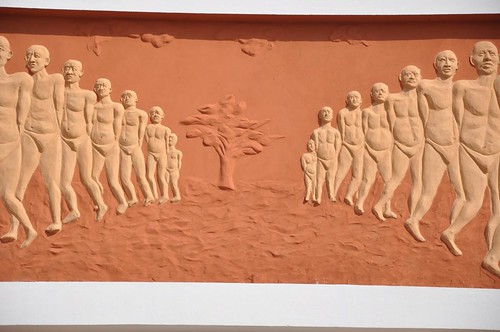
The mantle of the gate portrays bound captives leaving the shore of their homeland behind them, and marching towards the ship that will take them thousands of miles away into a life of servitude.


The other 3 "Doors of No Return" are in the other major centres of the slave trade in Ghana, Senegal, and Gambia. These are still within the original fortresses built as holding centres and trading ports.


The Bight of Benin, which includes the coastlines of Togo, Benin, and Nigeria, accounted for 20% of the Trans-Atlantic slave trade; over 2 million people sold into slavery over 250 years. The Kingdom of Dahomey, the predecessor to present day Benin, was involved in numerous conflicts between neighbouring kingdoms and empires. Dahomey forces conducted countless raids against these different ethnic groups, abducting and selling millions of individuals to European slave traders.


I think the most shocking picture I found while researching this post is this diagram illustrating the design of a slave ship so as to pack as many bodies in as possible. The conditions during the 1-6 month long Atlantic crossing would have been unimaginably horrific.


It's no wonder that an estimated 2.2 million Africans died at sea before ever reaching the Americas.

Also along the route to reach the waiting slave ships was a tree called "The Tree of Forgetfulness," which has ironically since fallen. A marker now stands at the spot where slaves were forced to circle the tree multiple times in a ceremonial ritual meant to erase their minds of their identity and memories of their heritage.

Memorial where the tree once stood
Once again, I've barely scratched the surface on this topic. If you are interested in a more in-depth look at this very dark part of the world's history, here is an excellent video:


On a lighter note, I am going ahead with travel plans, getting my flights booked with the help of Menno Travel (yes, a Mennonite travel agency-they're awesome), and have an appointment next week to make sure my vaccinations are up to date. I was able to cross one thing off my to-do list as well; I registered my travel plans with the federal government. Yay!

Monday, June 20, 2016

T Minus 35 Weeks and Counting...

As you can probably tell from the shiny new banner up there, I'm going back to work with Mercy Ships!

The Africa Mercy (AFM) recently finished its 2nd consecutive field service in Madagascar, returning to dry dock in South Africa for a couple months of R&R. After it's all shined up and ready for action again, it will be travelling up the west coast of Africa, to the small, West African nation of Benin, for another 10 month field service. The ship had been slated to visit Benin back in 2014, but the Ebola outbreak very close by led to the difficult but necessary decision to go elsewhere. The AFM is really not equipped to deal with highly infectious diseases, beyond the occasional case of chicken pox or flu. While there were never any cases of the virus in Benin itself, the rate at which it was spreading in neighbouring countries, plus the sheer number of cases (which had never been seen before), meant the risk was just too great. There are many other incredible organizations who stepped up to help during this crisis, ones who are much better equipped for and trained in dealing with infectious outbreaks. The surgical interventions Mercy Ships specializes in just aren't much help in that situation.

So, despite having already made some preparations in Benin, the ship was routed to Madagascar, on the other side of the continent, where it stayed for the next 2 years.

The WHO announced on March 29, 2016 that the "Public Health Emergency of International Concern" was ended, as the outbreak has been nearly entirely eradicated. Only two or three new cases have appeared in the last 3 months. Although the cost was tremendous, the death toll rising to 5 digits, the sheer amount of new data and resources the outbreak afforded has finally led to a vaccine being produced and trialled, which will hopefully prevent anything like this from happening again. Thousands of incredibly dedicated healthcare workers risked their safety to fight this horrific virus. 

Over 500 lost their lives. 

Thanks to this profound sacrifice, the region is now quite safe again, and Mercy Ships can continue their work of transforming lives; freeing them from debilitating, painful, and degrading afflictions. 

I am excited and honored once again to have the opportunity to be a part of this amazing service! I will be joining the AFM for 3 months in Cotonou, Benin at the end of February, 2017. And I CAN'T WAIT! 

I am so grateful for all the support and encouragement I received last year during my time on the ship, and I'm looking forward to yet another incredible journey with all of you. 

Last time around, I spent the last month before my departure trying to do 1 blog post a day about Madagascar. And, well, if you were reading, you saw how well that turned out. *cough* 3-posts-in-1-day-to-catch-up *cough* So this time I've decided to space things out a wee bit more, and do 1 post a week for 35 weeks. I will try again to provide some interesting tidbits about the country of Benin, as well as updates about my preparations and planning. 

So, to wrap things up for update #1:
  • I've received my official acceptance letter, digitally signed a pile of conduct & confidentiality forms, and am working on a few more. 
  • I'm saving up for the biggest initial expense: the plane tickets (hmm...layover in Turkey or Morocco?). 
  • I'm adding 100 things to my to-do list.
And for anyone that wants to skip 34 more blog posts but still learn a bunch of interesting stuff about Benin, here's a video: